

News
News
Post-war modernism? East German modernism? What's the difference?
A comment under a linkedIn post leads to questions and a little research trip. The answer lies in the architectural history of the post-war period, which unfolded in two systems that were similar but nevertheless different. It is a history that can still be seen today in the cities of East and West Germany and is increasingly recognised as worthy of protection.
A linkedIn post about Leipzig schools that were recently declared as monuments, titled “Plattenbauten des Sozialismus” (prefabricated buildings of socialism). The accompanying article uses the example of buildings, that are still in use today, including their architectural art, as a hook and discusses East German modernism in general. The article was published in the summer of last year. One user commented under the post: “There were prefabricated buildings in the West, too, school buildings made of concrete with flat roofs. Take a look at the school centres in North Rhine-Westphalia and Lower Saxony... Take a drive through the small towns and village centres.”
Once putting Chemnitz next to Cologne…
Oh dear. The author of the article did not think that far ahead. If the linkedIn user is right, is there any need for the term “East modernism” at all? What's the story behind this comment? So, we asked two people who should know. First, we spoke on the phone with Dr Ursula Schirmer, press spokesperson for the German Foundation for Monument Protection. She is sitting in her office in Bonn. She says: “Take a look at the opera house in Leipzig and compare it to the Beethoven Hall in Bonn. The two buildings speak the same architectural language and could be sisters!” So, there are clear similarities. But let's dig a little deeper, Dr Schirmer. If we put the entire city of Chemnitz next to the entire city of Cologne, isn't there a clear difference? Dr Schirmer's answer leads us to the differences between the political and economic systems of West Germany and East Germany until 1989/90. In Cologne, which was destroyed after the Second World War, most of the previous property ownership structures continued to exist. Though a lot of industrial construction took place on the outskirts of the city, architects also fulfilled the individual home ownership wishes of private builders and the public sector in other locations. This is still evident in the cityscape of today. In Chemnitz and other cities in Eastern Germany and Eastern Europe, entire neighbourhoods were often built according to a valid overall design. However, both architectural styles shared functional construction and industrial prefabrication. The reason was the same in both East and West: to alleviate the housing shortage in the destroyed cities.
The difference in detail… and in art
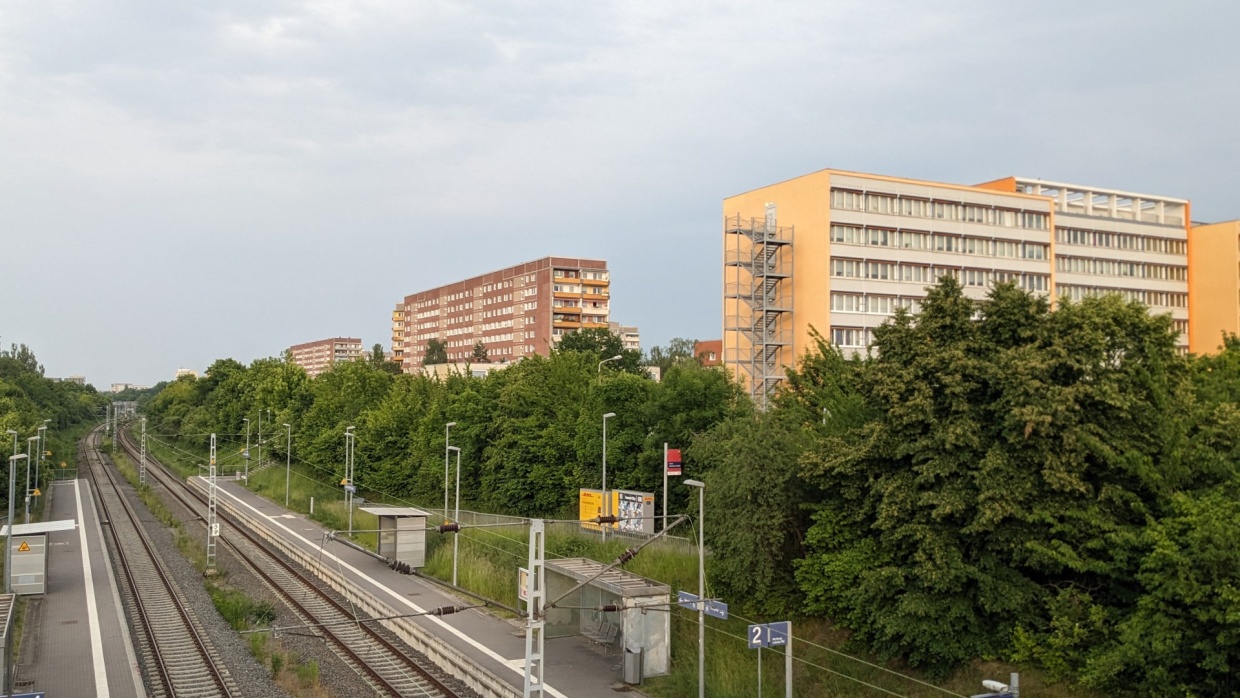
Marco Dziallas from the post-war modern architecture network “ostmodern” qualifies this statement somewhat. Yes, the Bauakademie in East Berlin was the authoritative body responsible for central planning and defining the specifications for industrial production. However, there were always adjustments made in the individual districts of the GDR. “And if you look closely, there is an enormous variety of prefabricated buildings in the East,” says Dziallas. “Balcony railings are shaped differently, the exposed aggregate concrete looks different, or coloured ceramics are sometimes used. Art in construction can be found in many public buildings of East modernism, such as schools, kindergartens, sports and cultural facilities.” Large residential areas were also built in the East. Dresden-Prohlis, the Fritz-Heckert area in Chemnitz, Halle-Neustadt, Jena-Lobeda, Leipzig-Grünau, and Berlin-Marzahn, to name just a few.” Dr Schirmer counters: “However, there were also large, serially built areas in the West! Take a trip to Cologne-Chorweiler!” All right, in addition to the small towns and village centres requested by the linkedIn user, Cologne's satellite town is now also on the list for the next road trip through North Rhine-Westphalia.
But Dziallas also sees the similarities. In addition to functionality and industrial prefabrication, the architecture in both East and West is straightforward and clear. The function that the building fulfils inside is thus visibly conveyed to the outside.
Young generations in both East and West appreciate and protect modernism
And what about the preservation of historical monuments? In the East, this is often a struggle, reports Dziallas. Dziallas and his fellow campaigners at the time were able to prevent the demolition of the former canteen of the VEB Kombinat Robotron in Dresden, not far from the Hygiene Museum. With his network “ostmodern”, he documents buildings that are facing demolition. And sometimes they even prevent demolition. Despite an increase in the number of buildings listed as historical monuments, including East modernist buildings, the registration of historical monuments in the East is generally rather slow. Often, the state offices lack the necessary resources and systematic registration is desirable.
Is there a need for the term “Eastern modernism”? Dziallas’ network actually encompasses both terms – Eastern modernism and post-war modernism. Evidently, both are necessary in order to avoid blurring the differences in architecture and the opposed systems of the time. However, in the end, it is all post-war modernism in purely linguistic terms. But then, why is it not called “Western modernism”, Dr Schirmer? “Well, the term “post-war modernism” was coined in the old Federal Republic even before 1989/90. The term “Eastern modernism” only emerged in architectural history after the reunification – to emphasise the independence of modernism in the East.” Both agree that further scientific research on the subject is essential, if only to be able to clearly distinguish and compare the terms in their temporal and regional dimensions. When dealing with the subject, it becomes very clear that formulating and differentiating precisely it is not so easy. Dr Schirmer: “If I had to write a PhD thesis today, I would raise a question on this topic.”
Note: The exhibition “PLATTE OST / WEST” opens on 28 February 2026 at the Stadtmuseum Dresden. It will be on display until 29 November 2026 – directly after denkmal in Leipzig, head a little further east and take a look 😉