

News
News
100 years Lorenz Leuchten: A winner of the Gold Medal is celebrating an anniversary
100 years Lorenz Leuchten: A winner of the Gold Medal is celebrating an anniversary
When Paul Lorenz founded his workshop in 1926, shortly before the outbreak of the Great Depression, the prospects for the business’s longterm survival were, in essence, extremely bleak. A hundred years later, Lorenz Leuchten is still in business – a family-run company that has weathered the Great Depression, National Socialism, war, the GDR regime and the profound upheavals following reunification. “I am particularly proud that we have carried on this legacy and that the company has endured for such a long time,” says Mario Lorenz, grandson of the company’s founder and its current owner. He attributes the company’s continued existence to its size above all else. The company has never had more than five or six employees. Lorenz: “A small unit is quite flexible. This flexibility is what defines the company. We can react quickly to any problem or challenge.”
This adaptability was particularly in demand following reunification. Part of the company’s previous production ceased. During the GDR era, the company manufactured watch cases, amongst other things. This part of production ceased completely after 1990. However, a major commission proved to be a lifeline: as early as 1988, Lorenz Leuchten was commissioned to recreate the historic light fittings for the Old Master’s Picture Gallery in Dresden’s Zwinger. The work continued until 1991 and helped the company through the economically difficult period of transition. “That was our lifeline,” recalls Lorenz.
Craftsmanship that connects generations
The traditional craft techniques, which still form the basis of the work today, would probably have delighted the company’s founder. After all: “If my grandfather were to walk into our workshop, he could start work straight away,” says Lorenz. Whilst computers are used today for tasks such as visualisations, the actual work processes have remained virtually unchanged. Grinding, polishing, painting and metalworking are still carried out using centuriesold techniques. “Today, the main priority is to ensure that this knowledge and these skills are not lost,” emphasises Lorenz. For him, preserving and passing on this knowledge is one of the central tasks of the craft.
Chandelier at the Buergergarten in Stollberg (Photo: Lorenz Leuchten)
A chandelier as a symbol
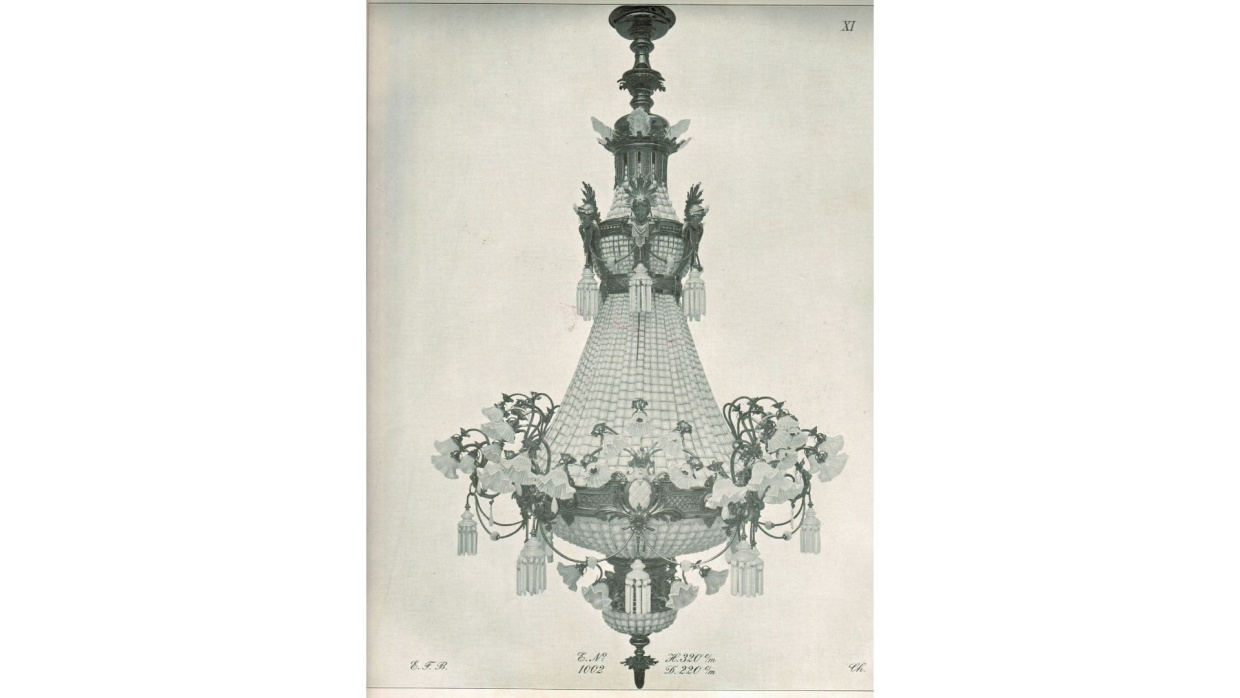
Just how much craftsmanship is required is illustrated by a project that has remained particularly vivid in Lorenz’s memory. For the renovation of the Bürgergarten in Stollberg in the Ore Mountains in 2012, a historic chandelier was restored; it had originally been manufactured in 1898 by the Chemnitz-based company Barthel for the World’s Fair in Paris. After the World’s Fair, the badly damaged piece was stored in the loft of an inn in Neukirchen near Chemnitz. When Mario Lorenz first examined the chandelier in 2011, it had already fallen apart into numerous individual pieces. He painstakingly reassembled it. When a suitable chandelier was being sought for the refurbishment of the Bürgergarten, the historic piece finally found a new home – just a few kilometres from where it had been stored for so long, alongside an exact replica produced by Lorenz Leuchten themselves. The restoration was later even featured on the television programme ‘einfach genial’. If any chandelier symbolises the company, it is surely this one. For Lorenz, however, a different chandelier represents the entire craft of beltmakers and metal-stampers. The one that also features in the company logo: a Flemish chandelier. This requires the application of every technique needed for this craft – from tube bending and surface finishing to metal stamping and electrification.
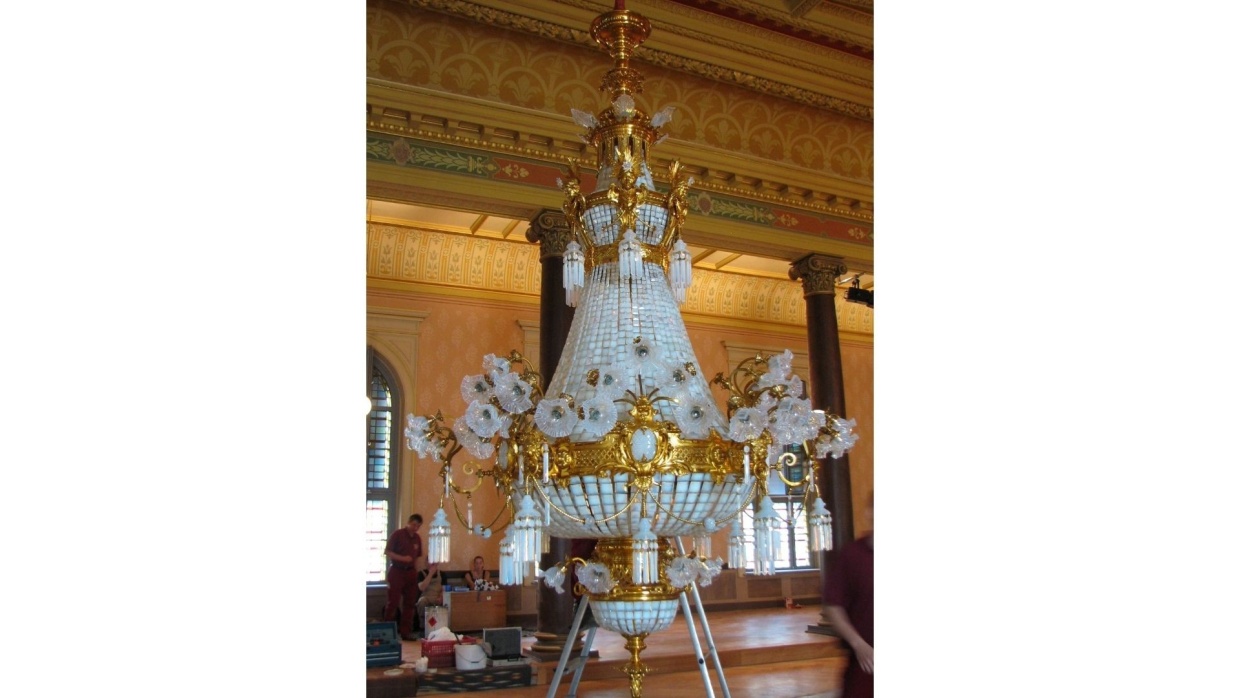
Installation of the chandelier in Stollberg. It was originally manufactured in 1898 by the Chemnitz-based company Barthel for the World’s Fair in Paris (Photo: Lorenz Leuchten)
2006 - Gold Medal for Villa Esche
In 2006, the company received a special recognition at the denkmal in Leipzig. Together with the carpentry workshop Sebastian Schulz, Lorenz Leuchten was awarded the Gold Medal at the time. The occasion was the reconstruction of historical interior details at Villa Esche in Chemnitz. The villa is regarded as one of the most significant Art Nouveau ensembles in Germany. It was designed in 1902 by the Belgian artist and architect Henry van de Velde as a total work of art, in which the architecture, furniture, lighting and even everyday objects were harmoniously coordinated in terms of design. A remarkable discovery proved to be a stroke of luck for the restoration: historical photographs showing the building’s original condition were found hidden in the roof structure and could be analysed. On this basis, numerous interior details, including light fittings and woodwork, were successfully reconstructed. The jury at denkmal recognised this achievement with the Gold Medal.
2026 – Again gold for heritage conservation
Twenty years later, the prize is to be awarded once again. The denkmal Gold Medals are regarded throughout Europe as one of the most prestigious honours in the field of heritage conservation. Since 1996, Leipziger Messe has been using them to recognise outstanding achievements in the preservation of cultural heritage.
Awards are given for, amongst other things, restoration projects, innovative technologies and materials, digital applications, the safeguarding and passing on of traditional craft skills, successful approaches to recruiting young talent, and exceptional civic engagement.
Anniversary as industry gathering
For Mario Lorenz, however, another event takes centre stage in this anniversary year: on 24 September, the company is inviting partners from the fields of heritage conservation, planning, universities, churches, politics and public building authorities to a specialist meeting in Chemnitz; the denkmal and, consequently, the Leipzig Trade Fair will also be represented.
The event is primarily intended to provide an opportunity for discussion and networking. Lorenz says: “Of course, we always meet at the denkmal too, but this time everyone we usually work with is coming to see us in Chemnitz-Grüna. And that’s great. The denkmal agrees – and offers its warmest congratulations!