


News
News
24 Diplomas – Warsaw, Where Resistance and Reconstruction Went Hand in Hand
The modernism of the post-war period – the last article on this topic explored differing terminology in East and West Germany and concluded: “It’s complicated.” But how do people in Eastern Europe describe the architecture that emerged after 1945? A new round of research begins, and it quickly becomes clear: the focus of this article must be Warsaw. Even though the city by no means represents all of Eastern Europe, the story of its reconstruction – and resistance – must be told once again.
What happens when a city is surrounded by a citadel and several forts? Its development comes to a standstill, urgently needed measures are postponed, the limited space becomes increasingly dense, and building upward becomes inevitable. This was the situation of the Polish capital Warsaw in 1918.
After Poland had been divided in 1772, 1792, and 1795 between Austria, Prussia, and Russia – disappearing from the map of Europe for more than 100 years – Warsaw was finally able to call itself the capital of the newly re-established Polish Republic. For the first time since 1795, when the First Polish Republic had been definitively divided, Poland regained sovereignty. Repeated uprisings had formed in response to these occupations. The November Uprising of 1830 / 31 in the Russian part, which included Warsaw, was the first major uprising of the 19th century. After its defeat, Warsaw’s cityscape was fundamentally altered – a citadel and several forts were constructed to prevent further revolts, shaping the city’s development for nearly a century.
Resistance – 2 uprisings, 24 diplomas
It is 1918: the Second Republic, founded after World War I, finally sovereign, finally with the opportunity to further develop Warsaw. This was a task taken on by architects such as Jan Zachwatowicz. However, the efforts by him and his colleagues were abruptly interrupted.
On 1 September 1939, Nazi Germany under Hitler invaded the Second Polish Republic, marking its end. Six years later, Warsaw lay in ruins – 65 percent destroyed, including 84 percent of the left bank of the Vistula river, where the historic city centre had been almost completely annihilated. The Jewish population, which had made up one-third of the city’s inhabitants, had largely been murdered during the Shoah. In 1943, many of them had risen once more in the Warsaw Ghetto Uprising, which was crushed by the Nazis. As a result, the ghetto was liquidated and the remaining inhabitants were deported to extermination camps or murdered on the spot.
Non-Jewish residents of Warsaw also suffered greatly under Nazi racial persecution. In late summer 1944, the Polish Home Army rose up against the occupiers, joined by Jewish survivors, in the Warsaw Uprising. The uprising was crushed in early October 1944, leaving the city devastated. By the end of World War II in 1945, Warsaw was a battered city whose number of inhabitants had decreased drastically. Some had fled, some had been forced to evacuate, many had been killed, many of the surviving had refused to submit to German terror.
Yet some of those who had planned Warsaw’s future before the war survived the Nazi regime. Among them was Jan Zachwatowicz, along with many others. A relatively unknown aspect of the Polish resistance in Warsaw: despite the official closure of the Warsaw University of Technology, it was in fact possible to study architecture there during the war. Initially led by Stefan Bryła, who was shot during a raid in 1943, and later by Tadeusz Tołwiński, a full curriculum was maintained. In total, 150 people studied architecture in Warsaw during the war, and 24 diploma theses were completed. This stands as a profoundly moving example of the functionality and resilience of the Polish Underground State from 1939 to 1945 – and of the power of human determination.
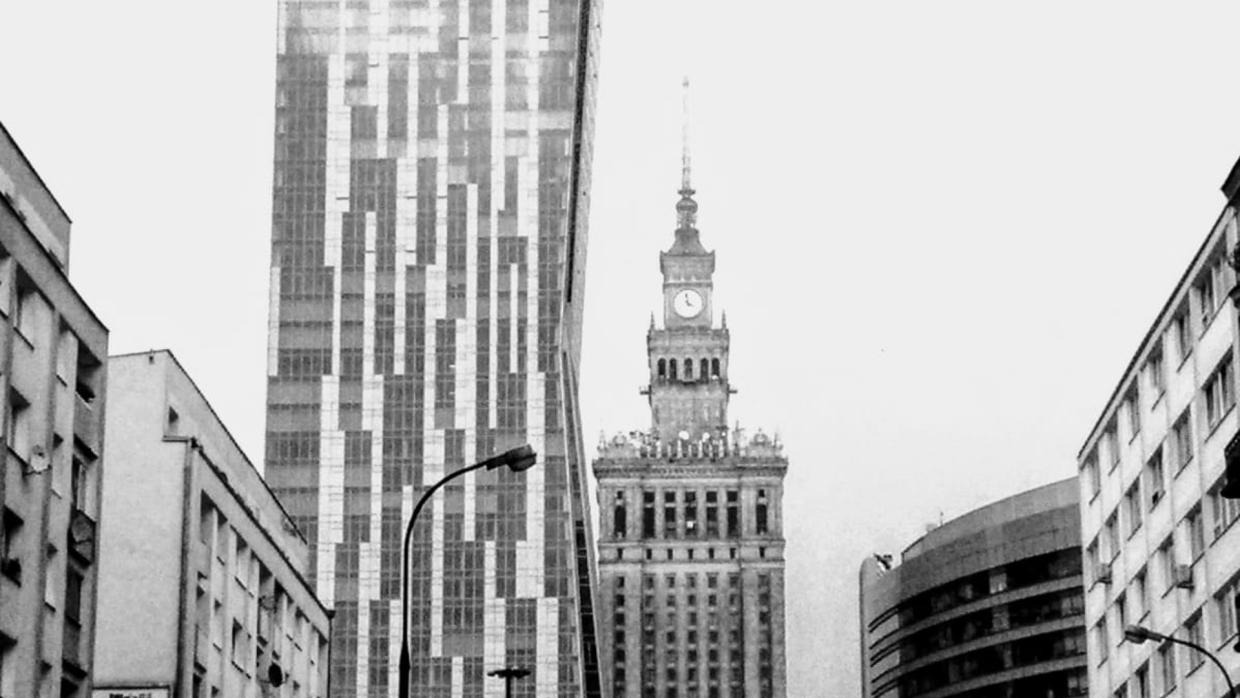
Palac Kultury I Nauki (Photo: Katarina Singer, Leipziger Messe)
Architecture as a political programme
With this knowledge preserved through catastrophe, the reconstruction of Warsaw began. Within ten years, the Old Town was rebuilt – an astonishing pace. At the same time, an entirely new urban structure emerged, based on modernisation plans developed before the war. Under changed political conditions – the Soviet-influenced People’s Republic of Poland was established in 1944 – architects like Zachwatowicz were finally able to act. Planning and land were nationalised, enabling large-scale interventions.
In the 1950s, architecture in Warsaw became an expression of the socialist state. The so-called Socialist Realism shaped central axes and squares. Monumental buildings with classical elements were intended to convey socialist strength and identity connecting people and state. In the Marszałkowska Dzielnica Mieszkaniowa (MDM), this blend of Socialist Realism and Classicism was implemented across 80 hectares. To this day, the interplay between representation and everyday life is evident: housing, shops, and cultural institutions were integrated closely together, conceived as a stage for social life under socialism.
At the same time, the housing shortage remained pressing. Soon, the focus shifted to efficient construction methods. From the late 1950s onward, standardized prefabricated elements dominated residential construction. Large housing estates provided quickly available living space for broad segments of the population and left a lasting mark on the city’s growth. In the 1970s, industrialized construction reached its peak. Entire districts were built in a short time, often based on standardized designs. Despite their uniformity, closer inspection reveals differences – for example in façade design or urban layout. This resulted in today’s multi-layered cityscape of Warsaw, ranging from historical reconstruction in the Old Town to monumental ensembles such as the Pałac Kultury i Nauki (Palace of Culture and Science), and to extensive serial housing developments.
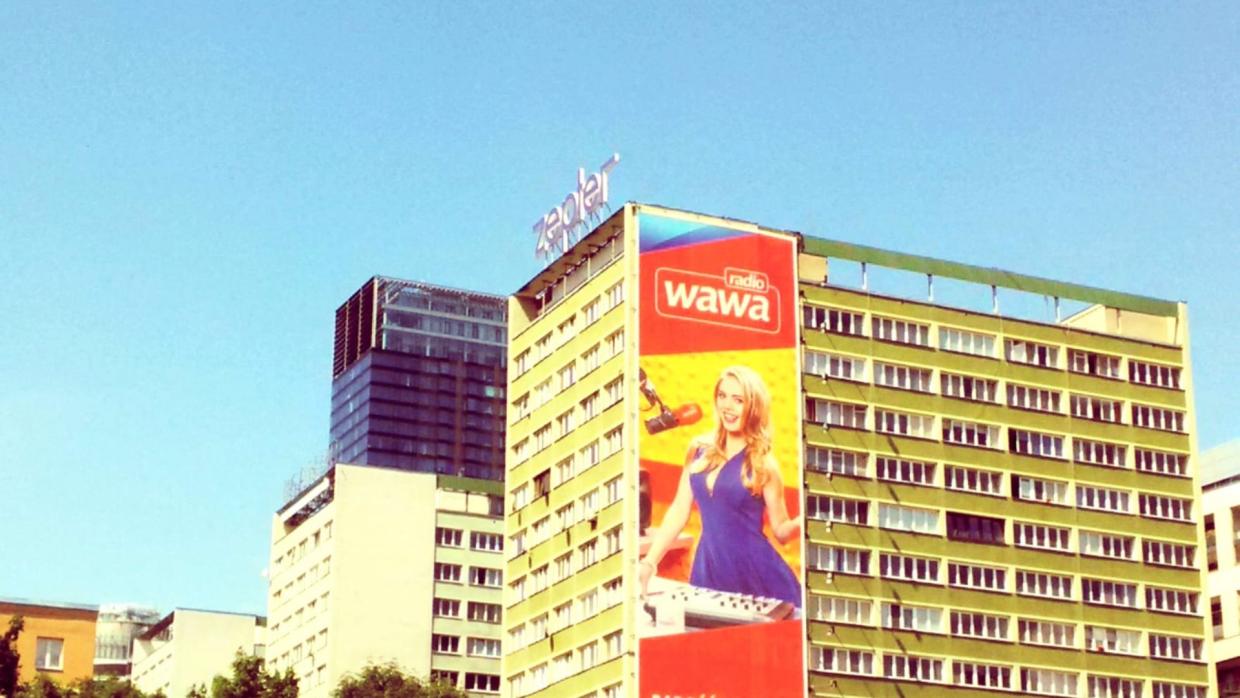
Cityscape Warsaw (Photo: Katarina Singer, Leipziger Messe)
Appreciated – the architecture of Socialist Realism
Today, Warsaw is a booming and thriving city, with contemporary architecture bearing witness to this development. But how do Warsaw’s residents – now living in the Third Polish Republic, which has existed for 37 years – view the architecture built after World War II? While entire ensembles like the MDM district and individual buildings are now protected as historic monuments, the value of more recently built large housing estates is still assessed in different ways. At the same time, interest is growing – driven in part by civic initiatives and a younger generation rediscovering the qualities of these neighbourhoods. Generous green spaces, social infrastructure, and urban clarity are increasingly appreciated. Particularly in Warsaw, there is also growing resistance to real estate speculation.
And what do people in Poland call the architecture that emerged after World War II under real-existing socialism? Terms like “East German modernism” or “post-war modernism,” as used in the German context, are not common. Instead, expressions such as Socialist Realism or communist architecture. In this respect, things seem a bit less complicated than in German language.
Originally, this article was intended to cover post-war or Eastern modernism across various countries of the former Warsaw Pact. In the end, it became an article about a single city in a single country. Dreams can shatter so quickly. Special thanks therefore go to Annamaria Orla-Bukowska, a social anthropologist from Kraków, who shared not only her knowledge of Warsaw but also insights into her own city; to Czech architect and member of the International Advisory Board of denkmal, Martin Tomášek – perhaps an article on the Czech Republic will follow next year, after denkmal 2026 – and to Anna Piasecka-Harvey and Francis Harvey for proofreading this article. Francis is Professor of Visual Communication in Geography in Leipzig, and Anna brings outstanding expertise on Warsaw.
This article was also significantly based on the 2021 publication by Małgorzata Popiołek-Roßkamp: “Warsaw – A Reconstruction That Began Before the War.”