


News
News
A profession turns 40! And every monument remains a mystery
Four decades ago, the first training course for “Craftsmanship for restauration” began at the academy of crafts at Raesfeld castle. One of its earliest participants was Harald Lemmler. Together with the current course director, Heike Notz, he looks back on the development of a profession that combines craftsmanship, science and responsibility for cultural heritage.
When he began the advanced training at the academy of crafts at Raesfeld castle in North Rhine-Westphalia in 1984, he had already passed the master craftsman examination in the painting trade. Two years later, Harald Lemmler also held the title “Restoration craftsman” and was therefore among the very first who were allowed to use it. Forty years later, he looks back and remembers that it was a small newspaper advertisement that first drew his attention to the newly offered course. As a result, he abandoned his original goal of becoming a graduate restorer. “It was a very pragmatic decision to want to carry this title. At the same time, I wanted to strengthen the theoretical approach to heritage conservation, because monument preservation happens both with the hands and with the mind.”
The later long-standing head of training at Raesfeld castle, Eckard Zurheide, had set himself the task of fundamentally designing and realigning the course content. He strengthened the theoretical foundation of the training: ethical questions of restoration and methodological approaches moved more strongly into focus, and systematic documentation practices became part of the curriculum. Since then, participants in the course have learned that a proper survey of the existing structure, damage analysis and planning of measures form the indispensable basis of any restoration concept. In this way, their work ensures that interventions remain comprehensible, reversible and compatible with the monument. A Herculean task.
“And Eckard Zurheide mastered it in an outstanding way,” says Lemmler, who, incidentally, served as an instructor in the Raesfeld castle course himself until last year. Since 2024, Heike Notz has been responsible for the programme. After successfully completing the course, participants can still call themselves “Certified restoration rcaftsmen”, with the additional title “Master Professional for craftsmanship for restauration”.

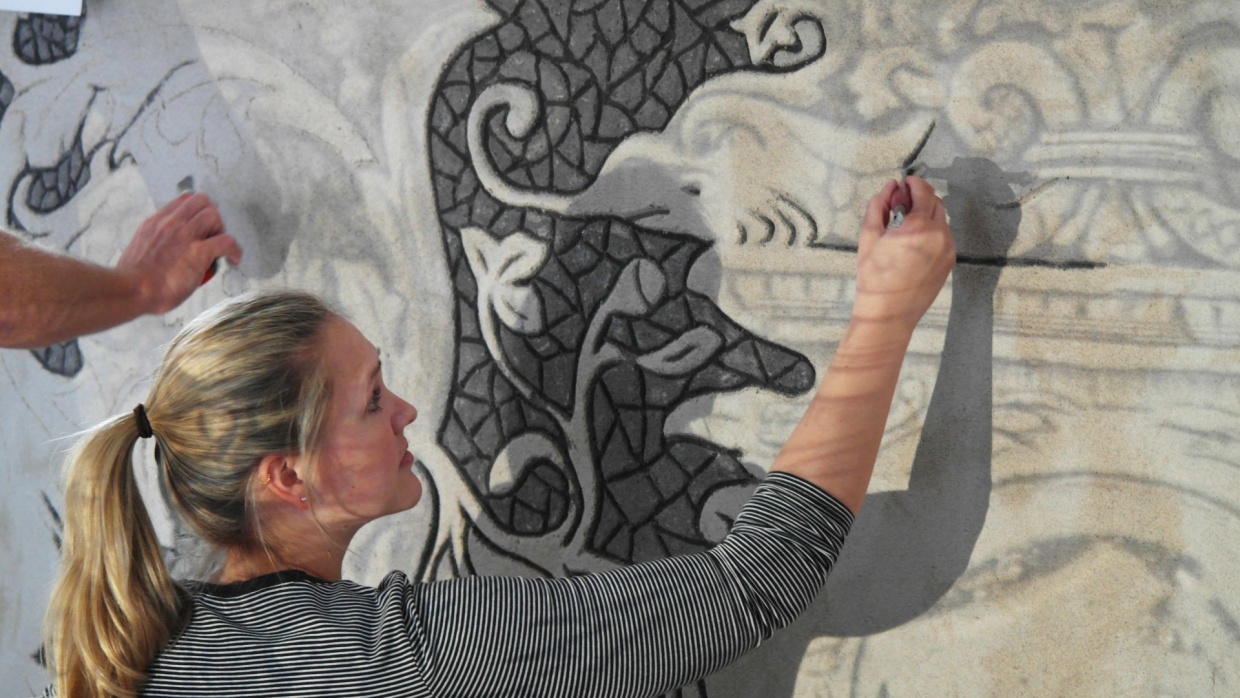
Photo: Harald Lemmer
How heritage conservation has changed…
Lemmler recalls that in the early years the main goal was to combine practical craft experience with a solid theoretical foundation in heritage conservation. Many participants were already experienced practitioners at that time — “seasoned heritage conservators, just without a title”. Accordingly, the motivation was pragmatic: they wanted to strengthen the quality of monument preservation. “After all, monuments were built by craftsmen. So, craftsmen are also capable of preserving them.” Since then, the field of work has changed significantly. Whereas traditional historical materials once dominated the focus, the material world of monuments has become far more diverse. “Today, monuments extend right up to our own time,” says Lemmler. The concept of “historic material” is therefore no longer clearly defined. New building materials, coatings and composite materials make analysis more complex and scientific investigation increasingly important.
For that reason, research consistently precedes restoration. “In fact, I can only begin once the analysis has been completed,” Lemmler explains. The process starts with surveying and documentation: history, materials and damage patterns. Only then a restoration concept could be developed. “It’s a bit like a criminal case — you first have to solve a puzzle.” This involves not only craft decisions but also societal expectations. Romanesque churches provide an example. Originally, many of them were plastered and painted — the lime plaster also served as a protective layer. Over decades, however, they were restored in a way that left the stonework exposed. “People have grown used to seeing churches like that,” says Lemmler. A return to the historical plaster would change the familiar appearance and might meet with resistance. It is precisely this complex balancing of factors that makes the work so appealing to him. Every restoration begins with questions. Owners often ask: “So what can be done?” The honest answer at first is: nothing yet. “Planning is often only possible once you have truly understood the monument.” The condition, materiality and the changes that have occurred over centuries ultimately determine the restoration approach. “It’s not a task you simply tick off,” he says. “It is an obligation toward cultural heritage. After all, destruction can only happen once — whenever work is carried out thoughtlessly.”

Photo: Harald Lemmer
…and how Raesfeld responds
The changing requirements are also reflected in the training programme. Around 70 participants are currently enrolled in various courses at the academy of crafts at Raesfeld castle, reports Heike Notz. With the introduction of the Master Professional, the natural-science component has increased significantly. Material analyses, damage diagnostics and scientific project work now play a much larger role than they did a few decades ago. “With this qualification we are also measured against universities — so the expectations are correspondingly high.”
Another important difference from the past: the restoration concepts developed for examination-relevant project work are no longer purely theoretical. “Participants now also have to implement them in practice,” says Notz. Project work has become more intensive and meets stronger academic standards — without neglecting the craft itself. On the contrary, the majority of the training remains the practical craft component. One goal is to prepare restorers in the crafts to work closely with architects, heritage conservators and other specialists — “on an equal footing,” as Notz emphasises.
While Lemmler describes how the materials of monuments are becoming increasingly complex, the training responds directly: with more analysis, more science and more substantial project work. At the same time, the core of the profession remains unchanged. “There must be no over-intellectualisation,” says Lemmler. “In the end, the craft in the literal sense is still essential — the work with one’s hands.”
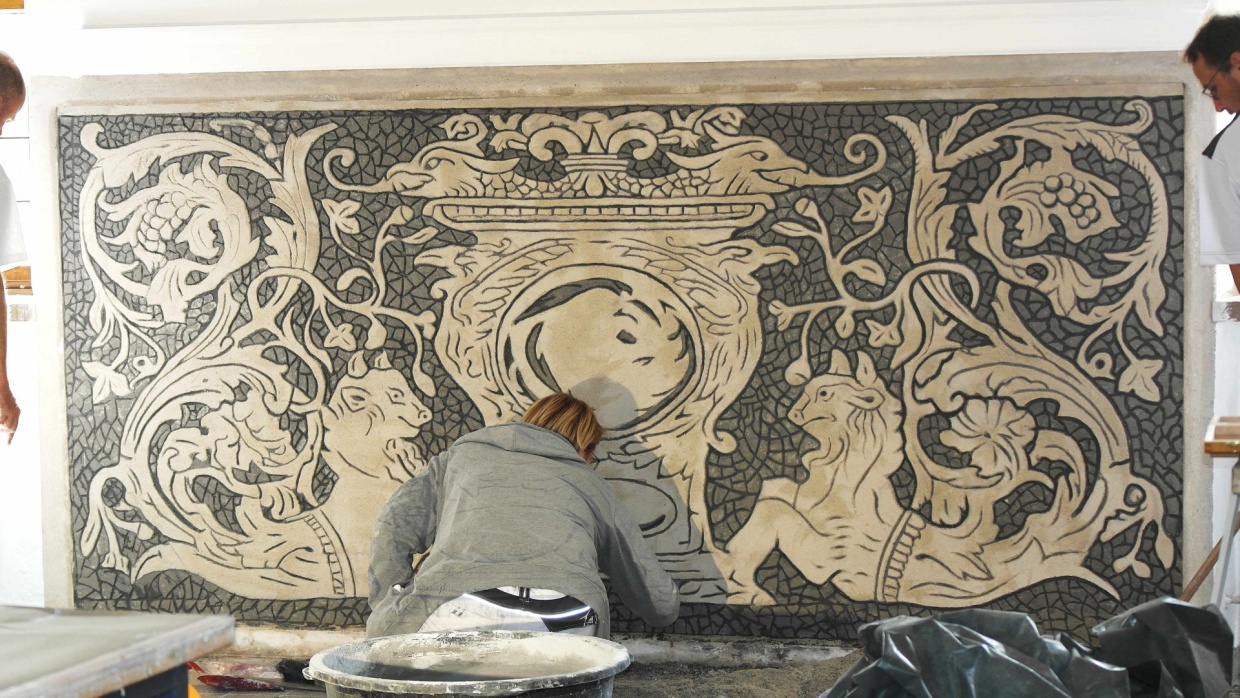
Photo: Harald Lemmer
Even in 40 years: ask first, then answer
This, Lemmler believes, is also a challenge for the next generation. Many young professionals today are excellent at digital planning and documentation, yet sometimes lack experience in practical execution. His advice is therefore simple: “Back to the basics.” At the same time, he encourages young people to pursue restoration in the crafts. The market is relatively small, shaped by small and medium-sized businesses — but the work offers extraordinary variety. “Every monument holds a secret,” says Lemmler. The task is to follow the traces left by the people who once created the structure. Heike Notz also looks optimistically toward the future of the training program. In fact, she says, not much needs to change. Demand is high and interest strong. As long as committed restorers in the crafts continue to be trained, the foundation for a high-quality approach to historic objects will remain secure. A new generation that, in Lemmler’s spirit, asks questions before offering answers — perhaps first taking a very close look, then analysing, developing a concept and, finally, beginning to work with their own hands. Even 40 years from now.