


News
News
An object alone won’t make the monument – on the power of photography
How does an architectural photographer approach his subjects? How is the debate between new construction and building within existing structures reflected through the lens of a camera? And how much creative freedom is involved in documenting listed buildings? Hamburg-based architectural photographer Piet Niemann has drawn a number of conclusions from his work and shared them with us.
Without photography, we would quite literally have no image of the buildings we discuss. Photographs give architecture – whether listed or newly built – its radiance. At least when it comes to architecture in public space. And this marks one of the key distinctions in Niemann’s work. “I find places interesting where people are present, where they interact – and I find those places in the context of public architecture,” he says. Private architecture, by contrast, often expresses a desire for retreat. Photography must usually engage with carefully staged interiors; people are almost entirely absent. Public space, however, is a place of spontaneity. It requires time – time to observe a building, to understand how people use it, and to wait for that one moment in which human interaction can be captured in a meaningful image. Niemann recalls a photograph he took in 2019 on Hamburg’s promenade: a father tying his son’s shoelaces. An everyday scene that perfectly illustrates his point. A stroll along the promenade interrupted by an untied lace, continued through parental care – within a brief photographic glance, a small story unfolds, complete with conveyed emotion. The promenade itself provided the setting that invited such strolling in the first place.

Image of the Hamburg Promenade / Shoelaces – Piet Niemann, on behalf of Zaha Hadid
Photography increasingly ienefits from work on existing buildings
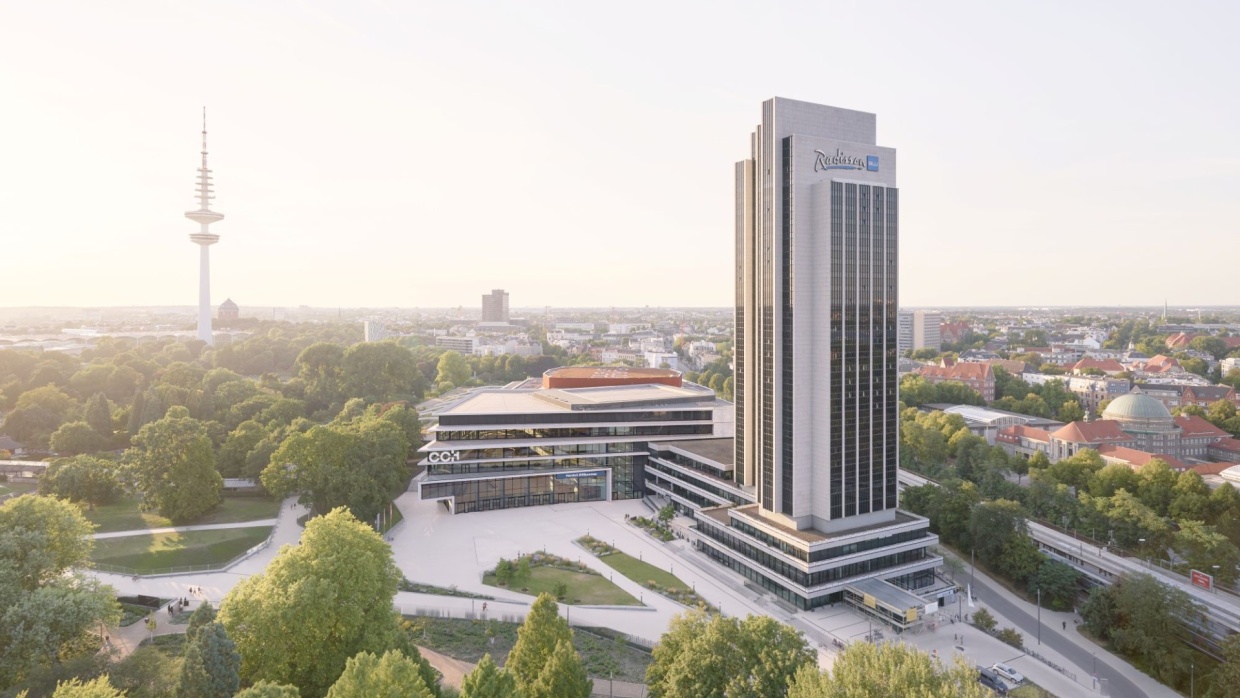
For a long time, Niemann worked independently when it came to listed architecture. Commissions were more likely to involve contemporary buildings. That has fundamentally changed. More and more listed buildings are being converted, and interest in photographic documentation from architects and owners has grown. Photographs serve as proof of work, documentation, and marketing. A prominent example is Boekhandel Dominicanen in Maastricht, the Netherlands. This former church, converted into a bookshop in 2007 by the Amsterdam-based office Merkx + Girod Architecten, evokes unmistakable “Harry Potter” vibes when browsing among the books – at least in a subjective reading of Niemann’s images. “In the Netherlands and Belgium in particular, there is a very progressive approach to the adaptive reuse of listed buildings,” Niemann observes. “This even extends to the deconsecration of former sacred buildings.” At the same time, he notes that building within existing structures requires courage. “You never quite know what to expect,” he says. A fitting example is Congress Center Hamburg (CCH). Amid the aesthetics – and technology – of the 1970s, 21st-century technology had to be integrated during the renovation from 2017 to 2022, overseen by the Hamburg-based architectural firm Hupe Flatau Partner. A complex and costly undertaking. And what role does documenting monuments play in Niemann’s work? He has experiences in this field as well. Several years ago, he documented buildings for Hamburg’s heritage authority prior to their renovation. Yet: “Aesthetics do not matter in that context. Other questions are more relevant – such as the size of a bench or the distance between two windows. I end up photographing with a tape measure in front of the lens.” It was work that did not entirely convince him.

Image of Boekhandel Dominicanen – Piet Niemann, independent production
Built for the moment – event-based architecture
For many existing or listed buildings, the question of adaptive reuse is becoming increasingly urgent. Often out of necessity, as societies change and buildings are no longer needed for their original purpose. However, in some cases, the issue is not reuse but continued use after a specific event – and in others, the question seems never to have been asked at all. One of Niemann’s largest projects – which earned him the European Architectural Photography Prize 2023 and the Bronze Medal of the German Photo Book Prize 24/25 – is the series “Expo 2000 – 20 years later.” Unlike many of his other works, these images are dominated by a misty atmosphere; light filters through a hazy veil. This was deliberate. “I consciously chose this approach because the vast site seems to be in a kind of Sleeping Beauty slumber. You can sense that something monumental once took place there – but now it is decaying.” Autumn weather and drizzle suited the mood. There was no need to wait for better lighting conditions, as he often does. The idea of sustainability appears to have been lost at Expo 2000 [Insights into his work on his website ]. For Niemann, this becomes particularly evident in the Dutch pavilion, where centuries-old trees were felled and used as structural columns for one of its many levels. “Thoughtless,” he calls it. Fortunately, a shift in thinking can be observed. The recent Winter Olympic Games in Milan / Cortina serve as an example: wherever possible, existing venues were used instead of constructing new ones. This may have come at the expense of a fully centralised sports experience, yet events such as the London 2012 Summer Olympics demonstrate the consequences of prioritising large-scale new construction – much of which now stands underused or in decline. After many such experiences, whether sporting events or expos, this approach is increasingly difficult to justify in democratic societies, Niemann believes.
What photography can achieve
Can photographs enhance – or even make visible – the value of a monument? Niemann answers with a clear yes. This applies to all buildings, as few people will travel to see a specific site in person. It is only through photography and publication that broad visibility is created. The Taj Mahal, the Empire State Building, the Sydney Opera House – very few Europeans will have seen all three in person, yet an image instantly appears in everyone’s mind when mentioning each. Such is the power of photography. Niemann cites a European example from his own city of Hamburg: the Elb Philharmonic Hall. Before its completion, many locals opposed it. “But when it opened, they were all instantly smitten. Suddenly, everyone had always supported it.” The radiance of the Elb Philharmonic Hall – extending far beyond Hamburg – would not have been possible without photography. Niemann is convinced that architectural photography will continue to endure. Computer-generated imagery did not replace it, despite predictions to the contrary, and artificial intelligence will not either. There remains a desire to see what the original idea behind a building was – and what it became in reality, a word he emphasises twice over. Moving images may be on the rise, but film struggles to achieve the same density of meaning as a photograph. Photography captures the human gaze and invites deeper engagement. Quite simply, it creates iconic images.
Further insights into Piet Niemann’s work can be found on his website.