
News
News
Applying technology? How Benediktbeuern brings research into practice
How can historic buildings be made more energy-efficient without compromising their architectural heritage value? What opportunities do digital technologies and artificial intelligence offer? And how can new knowledge be effectively transferred into heritage conservation practice? Volker Schweizer and Claudia Neuwald-Burg from the Fraunhofer Information Centre for Planning and Building IRB discuss these questions. Together with the Fraunhofer Institute for Building Physics IBP, the IRB operates the Fraunhofer Centre for Energy-Efficient Renovation of Existing Buildings and Heritage Conservation in Benediktbeuern. There, the IRB develops formats for sharing specialist knowledge, building expertise and testing new learning technologies. At denkmal 2026, the partners will bring the Benediktbeuern learning site to Leipzig virtually.
Ms Neuwald-Burg, Mr Schweizer, what do the Fraunhofer Institute for Building Physics IBP and the Fraunhofer Information Centre for Planning and Building IRB have to do with heritage conservation?
Volker Schweizer: Both institutes have been working on the preservation of historic buildings for many years. At the Fraunhofer Centre for Energy-Efficient Renovation of Existing Buildings and Heritage Conservation, they combine building physics research, practical demonstration and knowledge transfer. The IBP investigates technical and building physics issues, while the IRB prepares scientific findings for specific target groups and transfers them into practice through publications, continuing education and digital learning programmes.
Claudia Neuwald-Burg: The Fraunhofer Centre is located in the Alte Schäfflerei, an ancillary building of the historic Benediktbeuern monastery complex that was formerly used as a cooper’s workshop. The building is an ideal real-world learning site where complex issues relating to the renovation of existing buildings and heritage conservation can be conveyed in a concrete way. To this end, the IRB develops on-site and online continuing education programmes, digital self-learning resources and virtual learning environments. This enables research findings to be transferred into practice via a short route.
Historic buildings are supposed to be preserved as authentically as possible, while more and more factors have to be considered when working with existing buildings today – for example energy consumption, indoor climate and use. What are the greatest challenges?
Claudia Neuwald-Burg: Historic buildings cannot be treated with standard solutions. Measures have to be adapted to the individual building, and their impact on the historic fabric must be carefully assessed. From the IRB’s perspective, there is a second challenge: the knowledge required for this is distributed across many different sources and fields of expertise. It has to be discoverable, presented in an accessible way and linked to the specific tasks faced in practice. That is what we work on with our specialist information and training services.
Is there a research finding, project or development where you would say: this particularly clearly demonstrates the difference research can make to preserving historic building fabric?
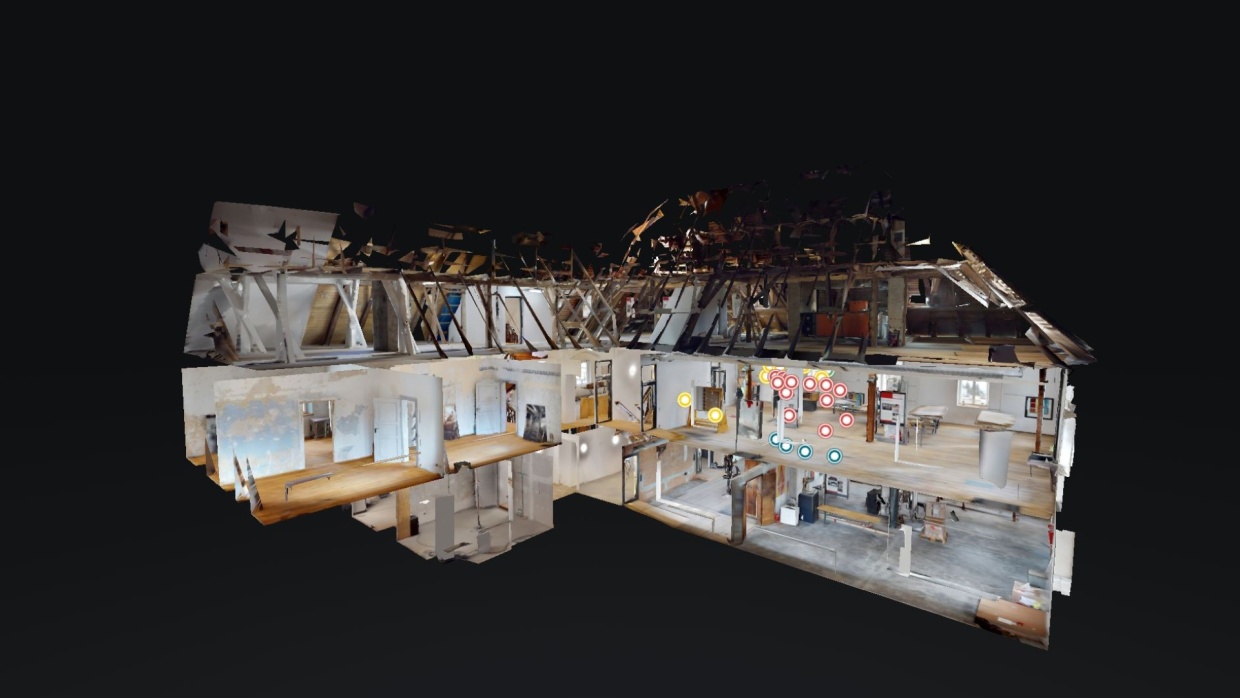
Claudia Neuwald-Burg: A particularly illustrative example is our QualiBene continuing education programme for the sustainable maintenance of historic building fabric. It combines digital self-learning phases and online exchange with practical work on the building itself. An interactive 3D building model supports learning based on specific findings and content. Participants therefore acquire not just individual pieces of knowledge, but learn to systematically assess complex existing buildings, identify interdependencies and develop viable solutions across different disciplines. QualiBene demonstrates what transfer-oriented research can achieve: existing specialist knowledge is not simply made available, but prepared, tested and communicated in such a way that it becomes professional competence for action. This is particularly important for historic buildings because individual measures can rarely be considered in isolation. Interventions in the building envelope, indoor climate or technical equipment influence one another. Heating systems, for example, are an excellent way of demonstrating how complex these relationships are – and how important it is to make them understandable for professionals working in practice.
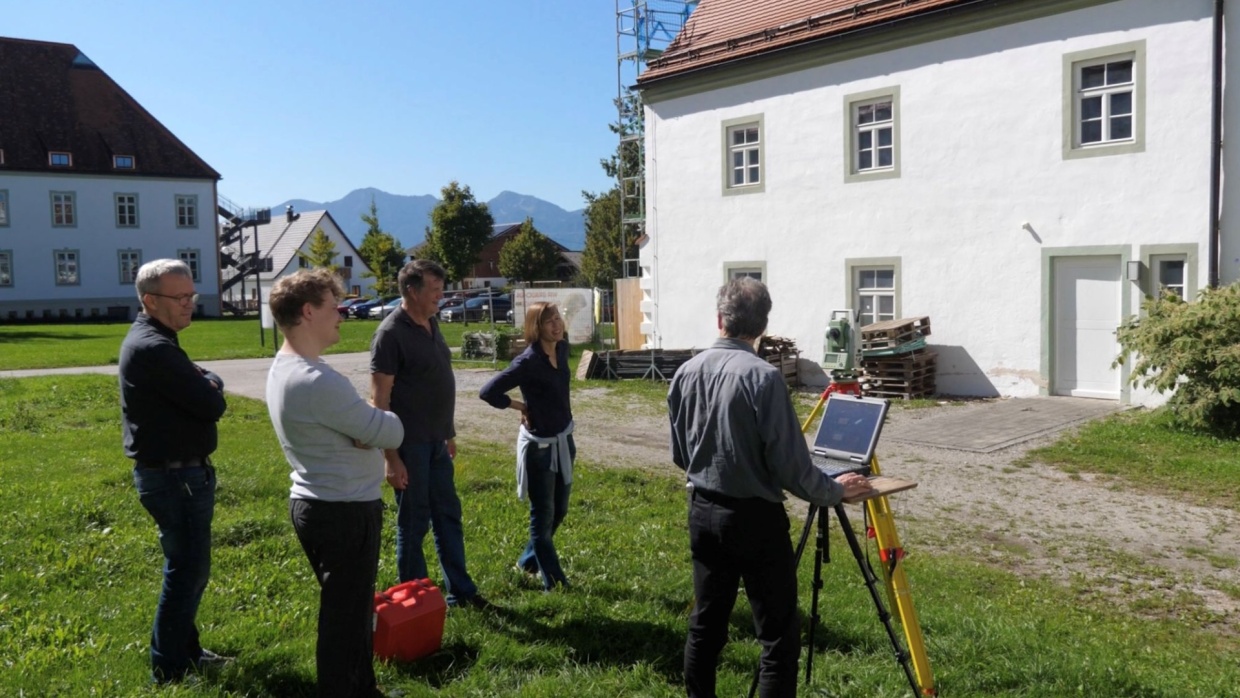
On-site visit to Benediktbeuern monastery. Photo: Fraunhofer Centre for Energy-Efficient Renovation of Existing Buildings and Heritage Conservation
Since you mentioned heating systems – what exactly are you researching in this area?
Claudia Neuwald-Burg: Research into heating systems themselves is not the IRB’s task. We are interested in how the existing specialist knowledge in this area can be communicated. Heating systems are particularly well suited as a learning example because their effects depend on many different factors and are hardly visible once a building is complete. At the Fraunhofer Centre in Benediktbeuern, we are developing case-based tasks, digital building models and immersive 3D visualisations. This enables professionals to compare different solutions and transfer the findings to their own projects.
Mr Schweizer, where do you see the impact of your research?
Volker Schweizer: The construction sector does not lack findings alone; it often also lacks suitable ways of transferring them into practice. Knowledge is distributed across many sources, does not reach all target groups or is difficult to apply to a specific task. This is precisely where the IRB comes in. We prepare specialist knowledge for specific target groups, make it accessible through publications and digital resources, and develop training formats that connect new findings with practical decision-making situations. Our work has an impact when professionals not only find knowledge, but can confidently assess it and transfer it to their own working context.
AI and digitalisation are currently transforming many industries, including numerous areas of heritage conservation. From your perspective, how will this affect work with historic buildings?
Volker Schweizer: For the IRB, it is particularly interesting to explore how AI can make heterogeneous information resources accessible for learning and knowledge transfer. Historic buildings are recorded in planning documents, architectural drawings, photographs, scans and texts. AI can help structure such sources and develop interactive learning objects from them. In immersive 3D environments, for example, building layers and complex interrelationships can be represented spatially. For such applications to be reliable, the data used, the specialist information and the educational design must be carefully reviewed. A virtual environment needs clear learning objectives and must enable the transfer of knowledge to real-world tasks. AI can support knowledge transfer; it cannot replace examination of the building itself or the judgement of qualified professionals.
Claudia Neuwald-Burg: For us at the IRB, the key question is how professionals can confidently integrate AI technologies into their everyday practice. Learning resources therefore need to do more than teach people how to operate a tool. They must also show what data the results are based on, what uncertainties exist and when professional oversight is required.
How will Fraunhofer be represented at denkmal 2026 in Leipzig?
Claudia Neuwald-Burg: We are bringing the Benediktbeuern learning site to Leipzig virtually. Visitors will be able to explore the Alte Schäfflerei digitally and experience how a historic building can become a learning environment. We will show how virtual models can make specialist knowledge tangible, reveal hidden building layers and support exchange between different professional groups.
Volker Schweizer: In 2026, we are deliberately placing the centre in Benediktbeuern at the heart of our presentation because it represents the interplay of knowledge transfer, demonstration and training. In addition to the virtual tour, we will present selected materials and demonstrators. Together with partners from building conservation and heritage preservation, we will also create space for professional exchange. In this way, our presence at the trade fair itself becomes a place for learning and networking. We want to make our approaches tangible and discuss with visitors what needs they see in the areas of continuing education and knowledge transfer. This feedback is important for our research because effective transfer programmes can only be developed if they respond to real-world requirements.
What do you expect or hope to gain from the trade fair?
Volker Schweizer: denkmal brings together professionals from heritage conservation, planning, the skilled trades, research and education. We want to present our approaches to knowledge transfer, gather feedback from practitioners and find new partners for research and development projects. We are particularly interested in which skills will be needed in the future and how continuing education can be designed to remain accessible and effective despite limited time and different levels of prior knowledge.
What open question relating to heritage conservation would you like to have answered by denkmal 2028?
Volker Schweizer: One key question for me is how we can ensure knowledge transfer for the preservation of our cultural heritage in the long term. Specialist knowledge is growing, while in many areas there is a shortage of time, staff and suitable continuing education structures. We therefore need to clarify how current findings can reach education, continuing education and everyday practice more quickly, and how digital resources can be meaningfully combined with exchange and practical experience. This also requires reliable funding. Cultural heritage is not an expendable cost factor; it shapes our identity, our cities and, not least, the local economy.
Claudia Neuwald-Burg: It is important to me that heritage conservation and the interests of owners are not seen as opposites, but as a challenge that can be solved together. Good solutions emerge when advice starts at an early stage and heritage conservation authorities, planners, skilled tradespeople and owners work together on the basis of shared knowledge. This requires sufficient staffing capacity within the authorities, but also easily accessible specialist information and suitable learning and exchange formats. This is precisely where the IRB can make a contribution.