

News
News
Between tradition and innovation
KEIMFARBEN has been active in the field of heritage conservation for almost 150 years. Managing Director Rüdiger Lugert speaks in this interview.
Which developments in the sector have had a significant impact on you during this time, in particular?
In short, over the last 150 years, heritage conservation has evolved from the ‘stylistically pure’ restoration of buildings to their original condition towards an increasingly value-based approach to preserving the existing built heritage. Over the decades, the focus has shifted from the protection of individual monuments to the preservation of entire urban ensembles, and increasingly to everyday architecture and industrial sites as well. Sustainability is also one of the current key issues in heritage conservation. The preservation of existing built heritage is a particularly important form of sustainable action.
Our company history and product developments reflect these stages. 150 years ago, our founder, Adolf W. Keim, developed silicate technology. Even back then, his aim was “to be able to pass on the artists’ creations to future generations in unchanging splendour and beauty …”. Since then, KEIMFARBEN has exclusively developed and produced mineral-based products and systems that have accompanied the architectural history of the 20th and 21st centuries and, in particular, the development of heritage conservation. Always with sustainability in mind, long before the term became so popular. Consequently, the move from a linear to a circular approach in 2022 was a logical step: 80 KEIM products have been awarded Cradle to Cradle Certified® Silver certification and the C2C Material Health Certificate™ at gold level. This represents 85 per cent of our product portfolio. In 2025, we were named winners of the German Sustainability Award in the category “Coatings and Paints”.
Why are mineral paints needed at all for use on listed buildings?
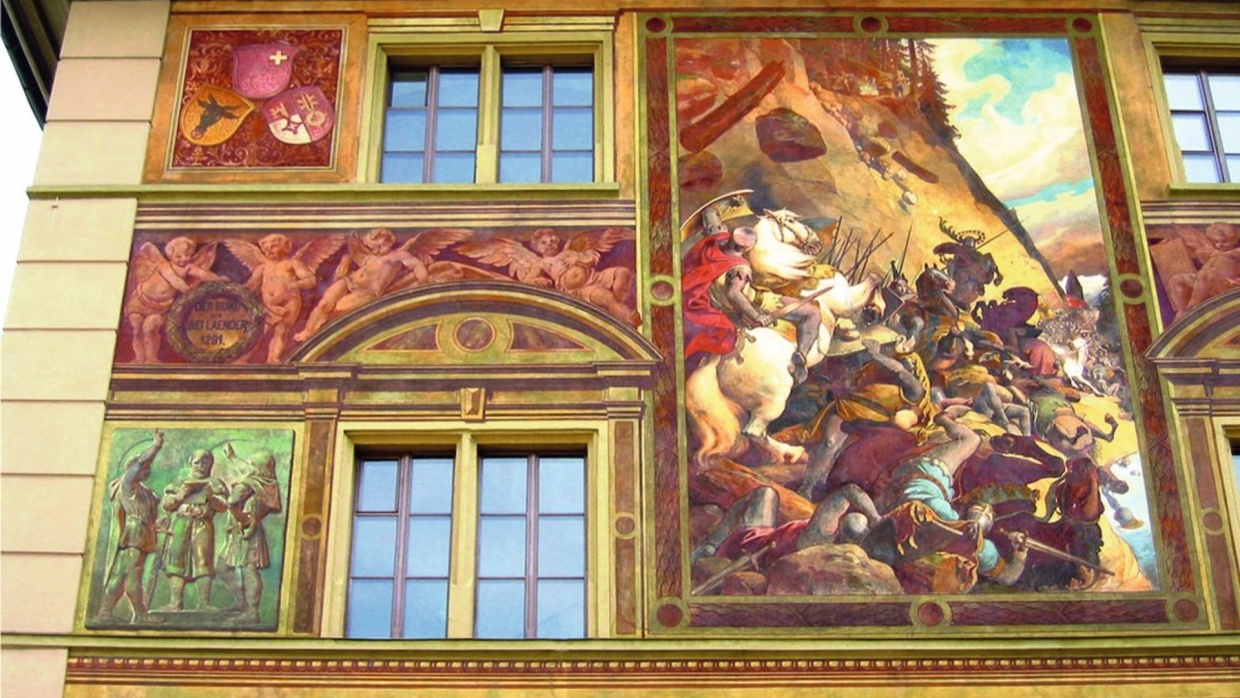
Heritage conservation measures often involve a balancing act between reconstruction that is as faithful to the original as possible, using historical materials, and what is technically feasible. This frequently applies to the choice of a suitable render and paint system as well. The materials used in the restoration and refurbishment of listed buildings must meet the highest quality standards in terms of protection and aesthetics. KEIM silicate paints contain only high-quality mineral ingredients: lightfast, inorganic pigments, selected materials as fillers, and mineral binders such as water glass or sol-silicate. The water glass binder is weather-resistant and, unlike dispersions, does not encapsulate the inorganic pigments within a film, but allows light rays to strike the pigment directly. The colours shine through the velvety-matt surface, displaying astonishing, lasting depth and high brilliance. The principle of silicification, whereby the mineral paint bonds with the substrate, creates a strong, indissoluble bond that ensures high durability and a significantly longer service life for the coating. Historically significant buildings such as Schwyz Town Hall, with its original KEIM paintwork dating from 1891, or the residential and commercial buildings in Stein am Rhein, provide impressive evidence of this. For all these reasons, KEIM’s mineral paints are a favourite choice amongst heritage conservationists and restorers.
What challenges do conservators and planners face more frequently today in façade and surface restoration work than they did ten or twenty years ago?
The effects of climate change are becoming increasingly evident. Changing temperatures and humidity levels are leading to more severe infestation by micro-organisms. Prolonged periods of heat and drought result in stress and shrinkage cracks. When carrying out refurbishments, planners must address issues such as energy efficiency and building physics requirements. And, as in many sectors, documentation requirements are increasing. All of this is intensifying the pressure on time and costs. At the same time, financial support in certain areas is being drastically cut back. The problems are not entirely new, but they are becoming more complex and occurring more frequently – and, unfortunately, often in an unfavourable combination.
Which project do you remember most vividly?
The Hall of Liberation in Kelheim, built in the mid-19th century on the orders of King Ludwig I. During subsequent restoration work, major alterations were made to the façade. As part of a comprehensive façade renovation in 2015, the aim was therefore to restore the original colour scheme and surface finish based on findings from the restoration work. Investigations carried out in collaboration with the Bavarian State Office for the Preservation of Historical Monuments revealed the original colour scheme. This showed that, against a light background, areas of the façade had been painted in subtly shaded shades of ochreyellow, pale pink, reddish and greenish.
Prior to the refurbishment of the approximately 5,000 square metre façade, damaged layers were repaired and weather-related damage accumulated over the past decades was rectified. This involved filling cracks, consolidating or replacing loose sections of plaster, and removing non-adherent layers of paint to ensure a suitable substrate. The final repainting was carried out using mineral-based products from KEIM, primarily KEIM Purkristalat. To replicate the historic appear-ance as closely as possible, the ashlar surfaces were finished by hand with a brush. This ensures that the nuanced colouration remains visible at close quarters, whilst from a distance the overall impression is one of a uniform surface. The work served both to restore the façade to its original appearance in accordance with conservation principles and to ensure the longterm protection of the historic building fabric – reliably and durably for the next 50 years.
Restoration of the Hall of Liberation in Kelheim. Use of KEIM Purkristalat to replicate the historic appearance as closely as possible (Photo: KEIMFARBEN)
KEIMFARBEN has been exhibiting at ‘denkmal’ for many years. What keeps you coming back to us time and again?
Heritage conservation is historically very closely linked to our identity; that is where our roots lie. That is why KEIM values ‘denkmal’ as the most important European information and business platform for everyone involved in the preservation of cultural heritage. We are looking forward to ‘denkmal’ in November. Visitors are already warmly invited to find out about the latest innovations and benefits of KEIM’s mineral-based product systems.
If you were to look to the future: what will heritage conservation look like in 2040 – and what role will materials and finishes play in this?
In our view, two of the topics already mentioned will become increasingly relevant: climate change and, closely linked to this, sustainable construction and renovation. This will also increase the importance of mineral-based materials, as they do not only meet aesthetic and heritage conservation requirements but – as described at the outset – are also more resilient to hygro-thermal stresses. Vapour-permeable and capillary-active surface systems help to wick away trapped moisture and reduce the risk of damage within the wall section. This applies not only to external render and paint systems, but also to plinth areas and mould-preventative interior sys-tems.
Sustainability will also increase the importance of mineral-based products. The decisive factor in the choice of materials is not their short-term technical performance, but their longterm environmental and social impact – such as low levels of pollutants, reparability, a long service life and transparency regarding raw materials. ‘Cumulative’ reparability will be particularly relevant in the field of heritage conservation – that is, not complete removal during refurbishment, but the possi-bility of partial restoration.
Our hope and aspiration for the future is that historic building fabric will be seen less and less as a shell that can be modernised at will, and more as a structure whose preservation can only be achieved through a deep understanding of its material and structural logic, and that the choice of materials is based on this understanding.