


News
News
Commitment in the City: Cooperative Housing and Heritage Conservation Hand in Hand
Managing one’s own building together as a tenants’ community, taking care of financing, and handling communication between all parties involved — all of this sounds like a lot of work. And often there are also heritage protection requirements to consider. Yet it is precisely this commitment from many people in Leipzig’s civic society that preserves existing buildings and ensures their restoration. At the same time, it contributes to maintaining livable neighborhoods with affordable rents. A look at the Solidarische Wohnungsgenossenschaft Leipzig eG, or “SoWo” for short, shows what lies behind self-managed housing in Leipzig’s housing projects.
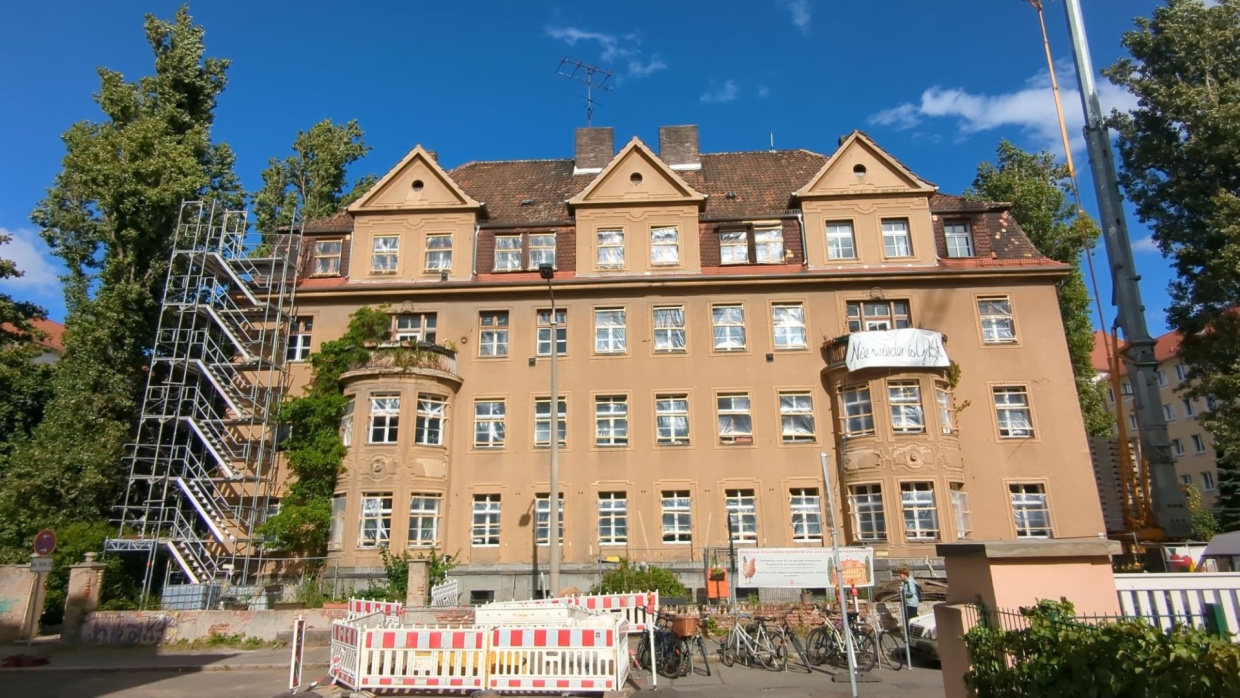
Bay windows and balconies give the building on Richterstraße in Leipzig’s Gohlis district an almost stately character. This was intentional: the building was constructed in 1924 for senior employees of the Central German Brown Coal Syndicate. It survived the Second World War almost unscathed, and during the GDR era workers moved in. What makes the building special today is that modifications and additions were made during every historical phase. However, a comprehensive renovation never took place, which means that much greater effort is required today. This work is now being carried out by an organization significantly shaped by the people who live there — the Solidarische Wohnungsgenossenschaft Leipzig eG, or “SoWo”.
Support from SoWo
SoWo can purchase buildings when tenants organize themselves and want to take responsibility for administration and renovation within the framework of the housing cooperative. This was also the case on Richterstraße. In 2023, the hereditary building rights agreement was concluded, the building was transferred to SoWo, and the tenants became co-owners. Years of struggle against gradual decay had preceded this step. Since the 1990s the building had been under the administration of the municipal real estate office, which, due to unresolved ownership issues, only carried out basic safeguarding measures. The families and shared flats living there gradually took responsibility for the building themselves, straightening roof tiles and repairing the fence.
Since the contract was signed, restoration work has intensified. The original box-type windows are being carefully restored and the spacious garden is being revitalized. This has been supported not least by funding from the German Foundation for Monument Protection and with the involvement of two volunteers from the Youth Building Workshops (Jugendbauhütten) completing a voluntary social year. Was heritage protection more of a burden or a passion? Michael Stellmacher, the SoWo project developer responsible for Richterstraße, says: “Heritage conservation was above all a matter close to our hearts. The residents felt it was important to preserve the building in its substance, including the materials it is made of.”
Heritage Conservation as an Instrument of Social Urban Development
One of SoWo’s first projects is located in Lindenau. The large Gründerzeit building on Georg-Schwarz-Straße was constructed before 1900. After an Austrian investor allowed it to deteriorate for years, only three tenants remained by 2017. Hopes for renovation in the near future were fading. At the same time, SoWo had just been founded. Even though it was newly established, it found a way to purchase the building from the investor. Today, a committed house community lives here in self-administration. Their situation is secured through a lease agreement with SoWo.