

News
News
Preserving knowledge, safeguarding cultural heritage: Traditional craftsmanship in Saxony
How can traditional craft knowledge be preserved and passed on to the next generation? In an interview with Ron Claus from the Leipzig Chamber of Crafts – a long-standing denkmal exhibitor – we explore training, hands-on experience, digital knowledge transfer, and the importance of international exchange for heritage conservation.
Mr Claus, craftmanship in heritage conservation in Saxony has undergone a number of changes in recent years. Where do we stand today?
Following the discontinuation of established training programmes in Trebsen and Görlitz, we have seen just how challenging it is to rebuild lost structures. Since 2025, the Chambers of Crafts in Leipzig and Chemnitz have once again been actively offering further training as a craft restorer across six building trades. In the first two year groups, we were able to attract almost 50 participants to this programme. Behind this, a large network of experts, businesses, institutions and industry partners has now re-emerged.
Why is it so important, particularly now, to pass on traditional craft skills in heritage conservation to the next generation?
The clock is ticking. The average age of the craft restorers we know of in Saxony is around 58 years. For some traditional techniques, there are now only a few experienced practitioners left. This knowledge is not just found in books, but in experience, manual skills, an understanding of materials and decades of practical experience. If it is not passed on in good time, it can only be rediscovered later at great expense. Particularly in the case of traditional craft techniques, which form part of our intangible cultural heritage, we must ensure that the next generation not only knows them, but also learns them, applies them and passes them on themselves.
What else do craftspeople need to learn in order to work responsibly on historic buildings?
Training programmes and masterclasses today must increasingly cover current regulations, standards, materials and procedures. However, the time available remains limited. With every new topic, knowledge of earlier construction methods and traditional techniques is pushed further into the background.
This is precisely where craft restorers and specialist tradespeople in heritage conservation come in. They deliberately look back: how were buildings constructed 50, 100 or 300 years ago, and why? What materials were available, what rules applied, and under what conditions was the work carried out? Only when I understand this, I can properly contextualise, appreciate and appropriately develop historic buildings.
What role does hands-on work on historic buildings play in your training courses?
Craft skills cannot be taught in the classroom alone. That is why our participants work on real historic monuments and on building components on a 1:1 scale. Every course includes a collaborative practical project. For example, our joiners are working on the restoration of Baroque door leaves at the Halbe Schloss (Half Castle) in Langenleuba-Niederhain, whilst the bricklayers are planning and constructing a cell vault. At the denkmal 2026 trade fair, traditional hand-joinery for a half-timbered model will take place in the ‘Gläserne Werkstatt’ (Glass Workshop). Such projects then provide an opportunity to bring together various techniques and trades.
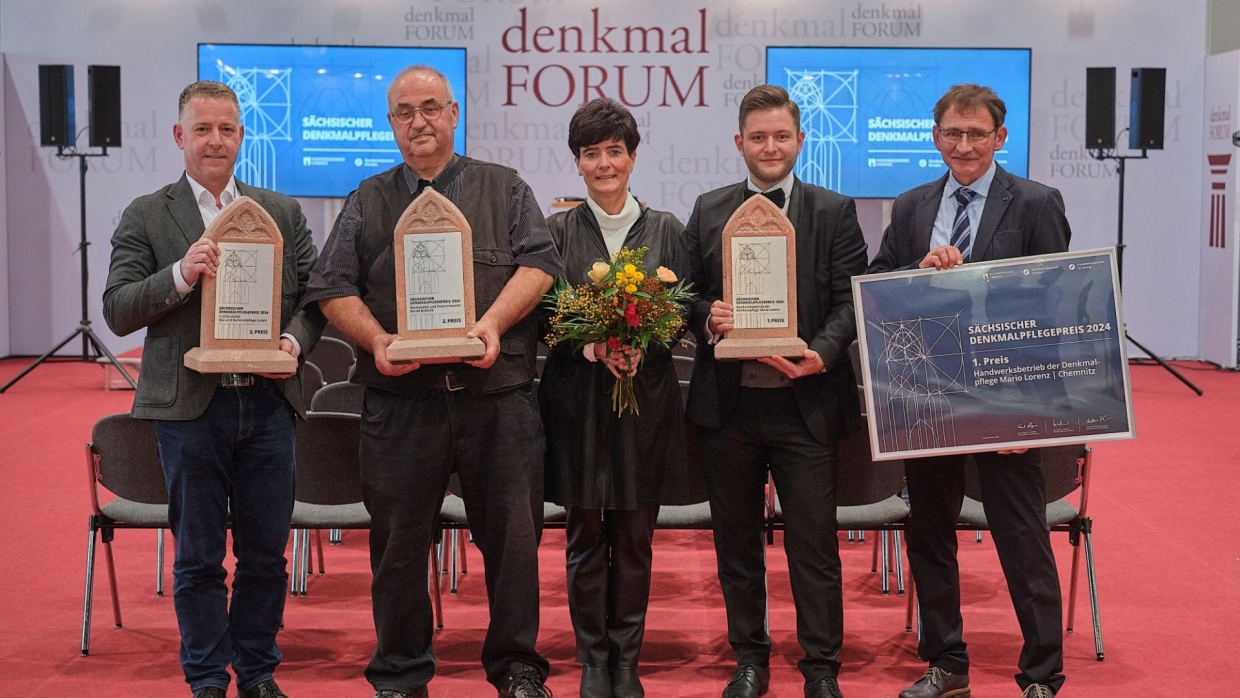
Presentation of the Heritage Conservation Award of Saxon Crafts at the denkmal trade fair, photo credit: Rico Thumser
Where does heritage conservation need innovation today, and where is the traditional craft-based solution still the best?
For me, innovation does not automatically mean high-tech. In heritage conservation in particular, innovation often involves developing a good, material-compatible and durable solution for a specific building. This demands a great deal of knowledge and creativity from the companies involved.
At the same time, in our continuing professional development programmes, we are exploring new technologies and processes, such as laser cleaning, radio-wave techniques, digital measurement and scanning methods, and other new possibilities. Participants should be able to familiarise themselves with these processes, try them out and form their own professional opinion: where does a new technology actually add value? Where is it not yet fully developed for my areas of application? And where does the traditional craft-based solution still make more sense?
What role do digital resources play in the transmission of traditional craft knowledge?
Since 2023, as part of the funded project on sustainable knowledge transfer in conservator training, we have been working intensively on the question of how practical further training and digital knowledge transfer can be meaningfully combined. This includes, for example, digital handbooks on heritage conservation practice and ornamentation, a VR tour of Leipzig’s Philippuskirche, one of our practical training sites, and video tutorials. The key question is always: how can digital tools help to make knowledge more visible, understandable and available in the long term, without replacing practical experience?
What additional topics do you intend to address in the coming years?
We intend to utilise the network we have built up and our experience to explore further subject areas. This includes, for example, the development of a training programme within the Golehm network on the restoration of solid clay buildings as a key component of regional building culture in Central Germany.
Another project focuses on historic plaster structures and the question of how recipes, production methods, repairs and, above all, the specific techniques used by experienced specialists can be digitally documented and adapted for knowledge transfer. Such approaches could later be applied to other traditional techniques.
You want to create more opportunities for people involved in heritage conservation to come together. Why is this exchange so important?
Heritage conservation cannot be carried out within a single trade. Craftspeople, architects, planners, heritage conservationists, academic conservators and researchers must engage with one another. Likewise, the various trades must understand how their work on a site interlinks.
For me, therefore, an important part of our work is to create spaces for interaction and professional exchange. It becomes particularly exciting when this gives rise to new ideas, partnerships and concrete projects.
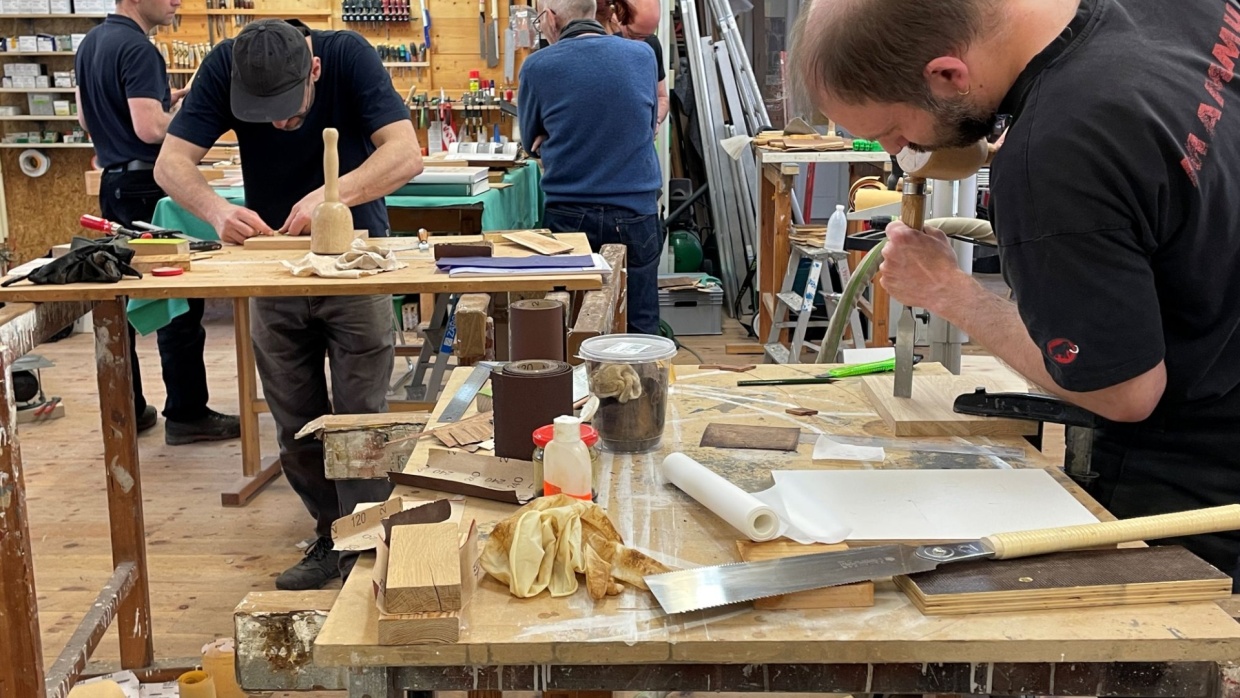
Marquetry exercises with restoration specialists in the joinery trade, photo credit: Leipzig Chamber of Crafts
You are increasingly seeking such exchanges at an international level. What can the craft sector learn from partners in other countries?
Our most recent discussions with partners in Italy, in particular, have shown just how fascinating an exchange based on very specific technical topics can be. How do craftspeople in different countries deal with comparable historical structures? What materials and techniques are used? How do site procedures and regional traditions differ?
Our aim is to develop specific exchange formats based on this, in which craftspeople from different regions and cultures work together and learn directly from one another. Many regions in Europe face similar challenges, particularly when it comes to preserving traditional knowledge based on experience.
What role does the denkmal in Leipzig play in this work, and what can visitors expect from you in 2026?
For us, denkmal is far more than just a presentation space. It is one of the most important meeting places for craft-based heritage conservation. At denkmal businesses, heritage conservation, planning, restoration, education and academia come together directly.
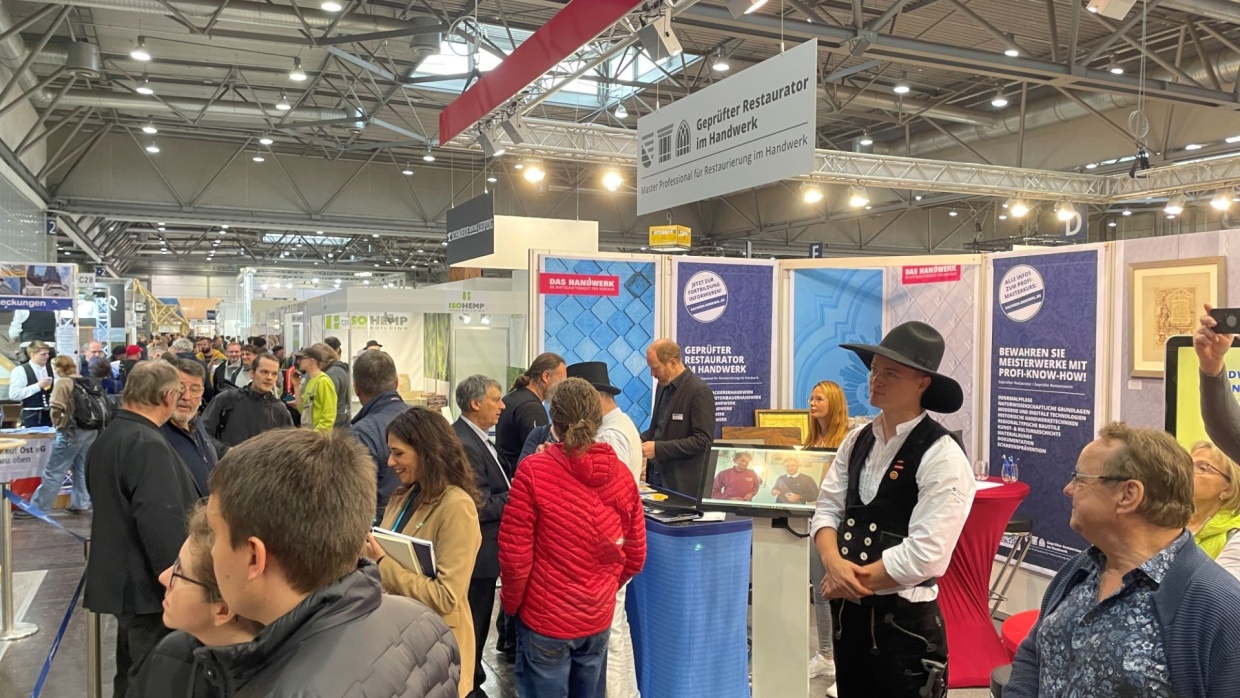
With the ‘Gläserne Werkstatt’ (Glass Workshop), we aim to bring craftsmanship to life in a hands-on way. In 2026, work will be carried out there on, amongst other things, a half-timbered model. At the same time, the Saxon joint stand will showcase the diversity of Saxony’s craft traditions. Within this framework, we will be able to authentically present our training and advisory services and projects, and engage directly with experts.
We also believe the Saxon Heritage Conservation Award belongs in this context. It highlights the quality, problem-solving skills and innovative strength present within the businesses.
As such, many strands of our work actually converge at denkmal: education, traditional craftsmanship, innovation, networking, recognition and, above all, personal exchange.
Further information from the Saxon Chambers of Crafts on heritage conservation in Saxony, as well as on further training and professional development opportunities such as the qualification as a crafts-based restorer, is available at sachsen-denkmal.de.