


News
News
Slate for historic roofs – Does its origin matter?
Restoring a historic slate roof is far from straightforward. The “original” slate from the quarries of the past is often no longer being extracted. So, how to deal with this? One option is to repair the existing roof. The other is to re-roof it. New slate is available, for example, from Spain. However, who extracts it and, above all, how important is its origin? And is that really the key question when it comes to slate?
There are only two slate quarries still operating in Germany: Altlay in the Hunsrück region and Fredeburg in the Hochsauerland district. That may come as a surprise. According to Olga Arkhipkina of the State Office for the Preservation of Monuments in Baden-Württemberg, slate is part of the cultural heritage of many regions of Germany. In Thuringia, Franconia and the Rhineland, the influence of neighbouring slate quarries can be seen in buildings. And not only there: Baden-Württemberg is also home to listed buildings with slate façades. This is unusual, as no slate suitable for roofing or façade cladding was ever extracted there. Arkhipkina has explored this heritage in various articles.
So why has slate mining in Germany declined so dramatically? According to Rathscheck Schiefer – one of the world's largest slate producers and an exhibitor at denkmal – there are several reasons. These include deposits that are difficult to access and lengthy regulatory procedures for opening up new extraction sites, while resources in existing mining areas have been depleted.
So, what can be done when restoration work requires more new slate than the two remaining German quarries can supply? Arkhipkina argues that existing slate can be preserved. Rusty nails can be replaced, and individual slate tiles can be exchanged using a technique known as Nachstecken (~ plug back in). This involves using new slates or historic ones salvaged from demolished buildings. Another method currently still being tested is conservation. In this process, the slates are impregnated with epoxy resin – a hardening synthetic material – allowing them to remain on the roof for additional years.
According to Rathscheck, these measures are generally not economically viable. In many cases, renovating the existing roof is more cost-effective, as slate roofs have a long service life. When re-roofing is necessary, slate extracted in Spain is generally used today – slate quarried locally by Rathscheck’s subsidiaries from their own deposits.
Origin is secondary; quality is key
Rathscheck’s subsidiaries supply slate to Germany, among other markets, where it is now also being used on listed buildings. In a conversation with Frank Rummel, a member of Rathscheck’s management team, it quickly becomes clear that the company rejects the term “Spanish slate”. What matters, he says, are the geological characteristics of the respective deposit and therefore the mineralogical composition of the slate.
Rathscheck aims to meet heritage conservation requirements with a slate specifically produced for the Altdeutsche Deckung, the traditional German method of slate roofing. Rummel explains: “Heritage conservation requires an authentic, historic townscape. The Altdeutsche Deckung in particular meets this requirement, but only if it is executed in accordance with the relevant professional standards.”
This requires clearly defined slate formats, as these are the only way to create the characteristic tapering of the roof covering. As the roof rises, slate stones with progressively decreasing heights are laid. “As a producer, we have to ensure this variety. But that is not possible with every deposit,” says Rummel, explaining: “Not every deposit can provide the full range from large to small slates. With our own high-quality deposits for the Altdeutsche Deckung – which are located in Spain – we are able to meet this requirement.”
Good slate deserves good craftsmanship!
Olga Arkhipkina also considers the Altdeutsche Deckung, with its varying slate heights and widths to be of particular importance from a heritage conservation perspective. Historically, she explains, there were no standardised templates for the Altdeutsche Deckung. Every slater shaped each individual slate by hand. As a result, every roof was a work of art in its own manner.
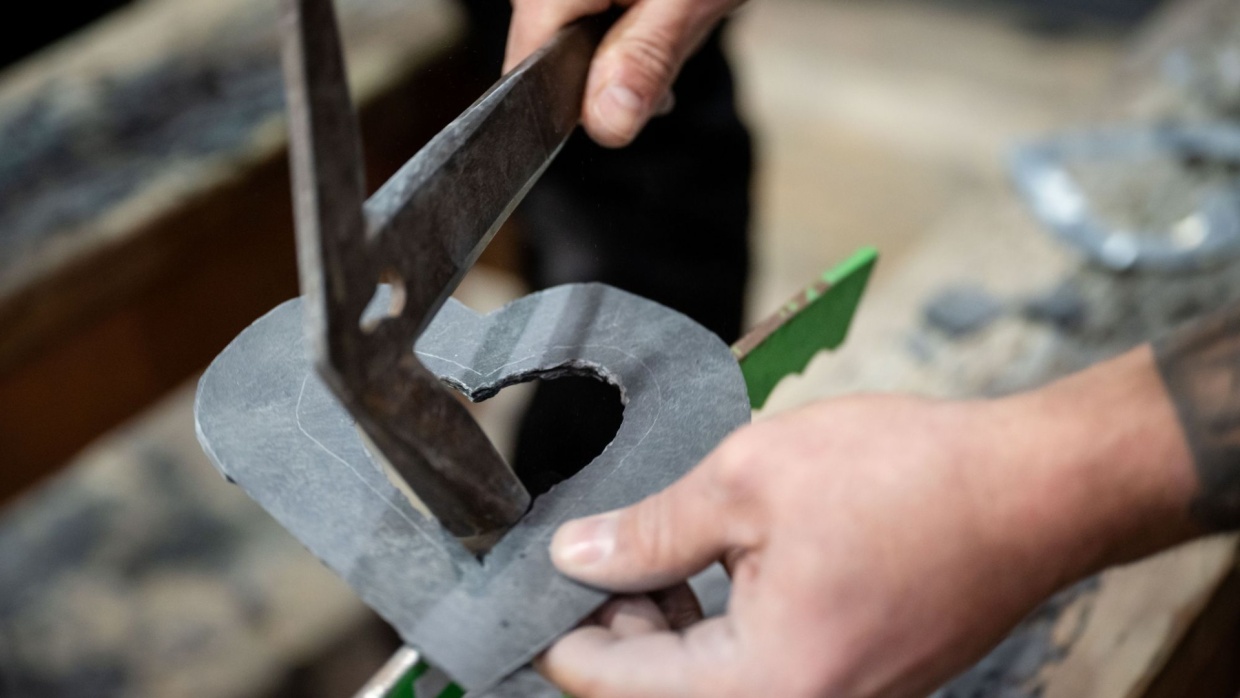
Today, things are different. Rathscheck has also automated the production process for slate used in the Altdeutsche Deckung – a challenge given the many different variations of slate that have to be taken into account. Frank Rummel explains that Rathscheck uses clearly defined slate formats for the Altdeutsche Deckung. Even today, however, slaters still need skill and craftsmanship. Slate used at the eaves, ridge, valleys or hips – in other words, wherever two roof surfaces meet – still has to be shaped on site.
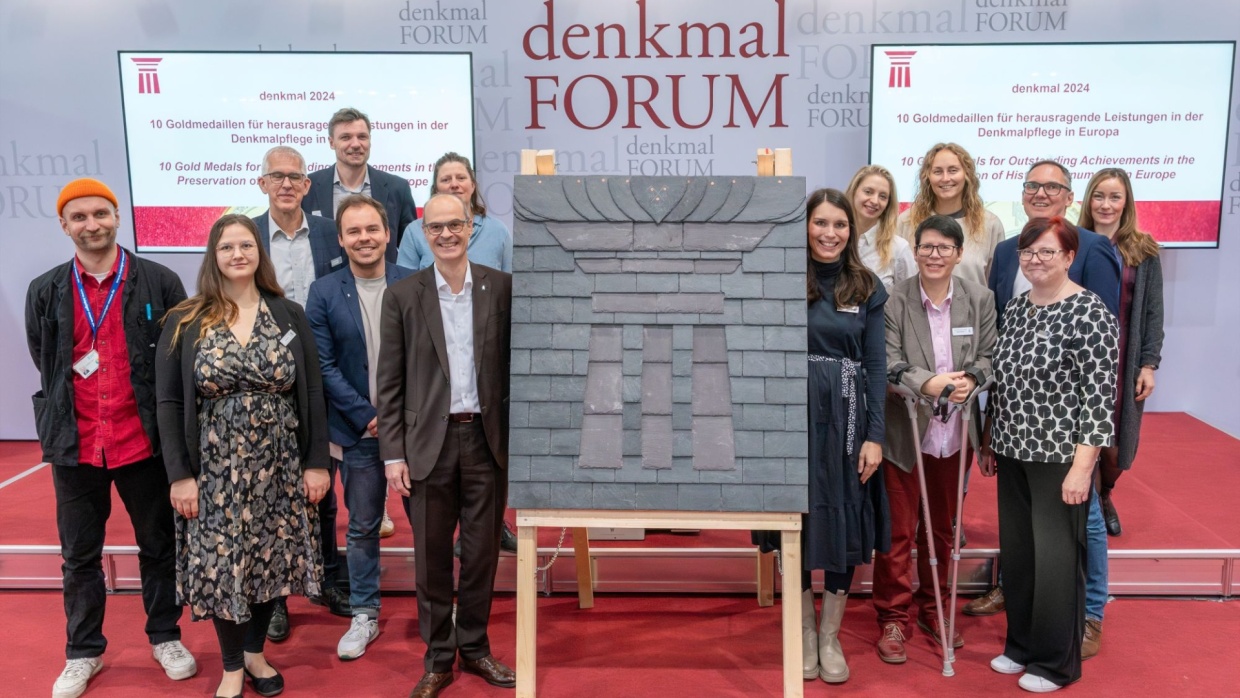
At denkmal 2024, the trade fair team received the denkmal logo carved in slate as a gift from exhibitor Style Dach. I wonder which type of roofing was used for it? Photo: Leipziger Messe
The really decisive question
For Arkhipkina, the key issue ultimately comes down to weighing up repair against re-roofing. Each case, she says, must be assessed individually. She explains: “Removing historic slate cladding in favour of a new roof covering when the damage is minor would mean an immense loss of original building fabric. The value of a historic roof covering – especially on a listed building – cannot usually be assessed solely in terms of economic efficiency.”
And what if a roof does have to be re-covered? She, too, acknowledges that there are differences in quality between individual slate quarries. What matters to her is, firstly, that the slate is of the according quality and, secondly, that the roof covering is installed correctly according to professional standards. When in particular historic roofs a historic Altdeutsche Deckung have to be renewed, there is a risk that, that due to cost considerations, a standardised templated covering will be used instead. When that happens, a significant degree of both aesthetic quality and craftsmanship is inevitably lost.
One thing is clear: the initial investment in high-quality slate is substantial. However, it pays off over time. A properly installed slate roof with high-quality, rust-resistant nails can last for 100 years. Many other types of roofing last only half as long.
And one thing becomes clear: when it comes to slate on listed buildings, the question of whether to repair or re-roof appears to be one of the most decisive and hotly debated issues. Compared with this, the question of where the slate comes from seems to be somewhat less important.