
News
News
“The bridge we are building is called communication”
How can innovations in heritage conservation be brought into practice more quickly? And why is dialogue between science and the skilled trades so crucial to this process? In this interview, Prof. Dr.-Ing. Alexander Stahr of HTWK Leipzig talks about DENK(M)AreaL, one of the new features at this year’s denkmal, and about the question of how much heritage we can still afford.
Professor Stahr, DENK(M)AreaL – you’ll have to help our readers here: what is the best way to pronounce it?
The play on words is open to interpretation – and that is very much intentional. The “M” stands for the trade fair, but also for courage and motivation. We want readers to pause for a moment and ask themselves what lies behind the name. The English word “area” is also part of it, referring to a specific section of the trade fair. But it is simply pronounced “Denkmareal”.
And who will be represented in this area, this section of the trade fair?
DENK(M)AreaL is a collaborative project currently involving 13 companies and five research institutions. The interaction and collaboration are based on various forms of cooperation. It brings together people and organisations that have got to know and appreciate one another over the years.
One example of what can emerge from such collaborations is the ARsist research project, which is embedded in the InTraBau innovation community and receives public funding. The project is developing a method for using augmented reality technology with special data glasses to digitally record listed structures and display renovation and planning concepts for practical use in construction. The project is being implemented together with Bennert, a company based in Klettbach, Thuringia. Using digital tools available on the market, planners can record situations on site and feed this information directly into the planning process. Skilled craftspeople, in turn, can use the same technology to access planning information or display it in the relevant context. In the future, this could make paper plans largely redundant and allow specific information to be displayed according to the context in which it is needed.
The aim of DENK(M)AreaL is to bring innovations to market more quickly. What are you observing – why is this happening too slowly?
One reason why innovations have such a hard time establishing themselves on the market is that construction is a highly differentiated process involving many different stakeholders who repeatedly come together in new constellations. As a result, a great deal of energy and time is often spent organising projects. That time is then lacking when it comes to thinking through ideas and putting them into practice.
Nevertheless, innovation is taking place! However, because science is largely funded by public tax revenue, we expect innovations to be made available to as many stakeholders as possible – ideally to the entire industry – rather than remaining with a single company.
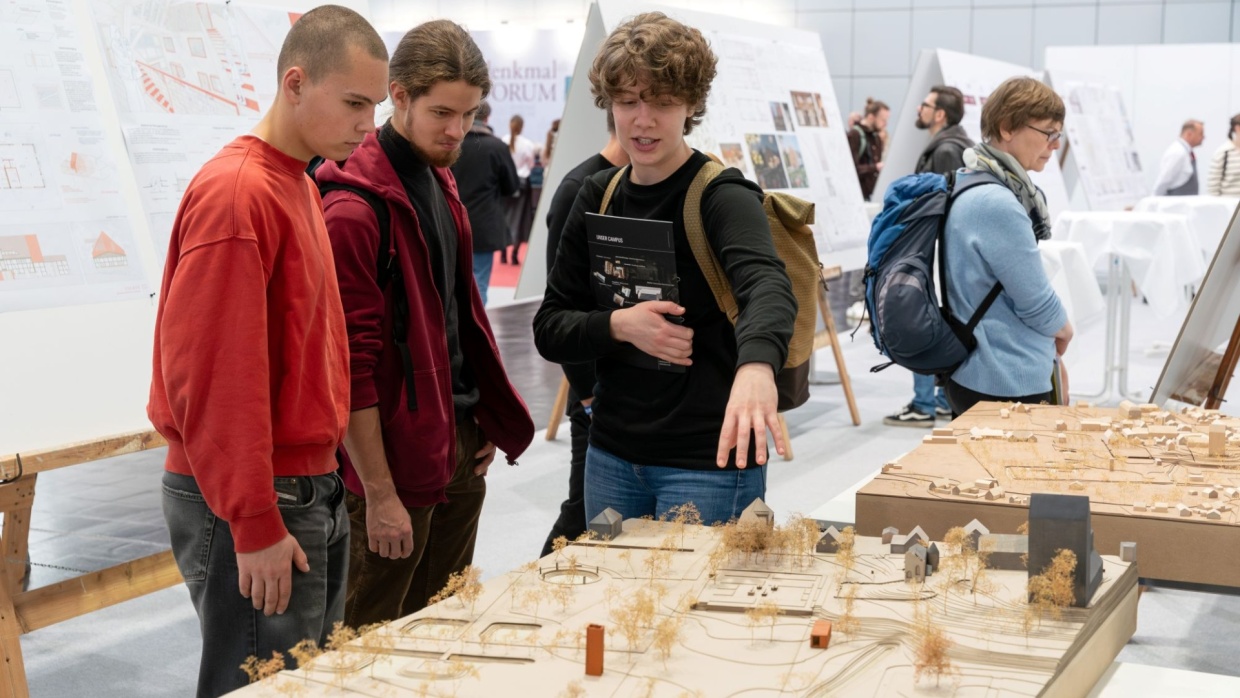
Thinking together about heritage – that is what denkmal is all about. Photo: Leipziger Messe
From my perspective, the different perspectives of academically oriented research and practical craftsmanship often result in a relatively large gap. We need to close that gap in order to bring more innovations to market more quickly. The need is enormous. Our mission is to build a bridge. The building materials this bridge is made of are communication, understanding, curiosity and respect.
What is your personal connection to heritage conservation, and how did it come about?
I am a trained craftsman myself, and I am proud of my journeyman’s certificate as a construction worker. During my youth and also while studying, I worked extensively on conversion and renovation projects, both with and without a heritage conservation context, and gained a great deal of experience in the process.
That is really the core of my experience. I became aware of heritage conservation issues very quickly and tried to take them into account in the respective projects. These experiences continue to have a profound influence on my research and teaching to this day.
Perhaps the question should be reversed: how did you get into academia?
After completing my vocational training, I studied civil engineering at the Bauhaus University Weimar. By a stroke of luck, I was able to stay at the university and move to the Faculty of Architecture as an assistant to Professor Jürgen Ruth. During this time, I became familiar with the design and spatial-conceptual aspects of planning and construction. After several years working in planning practice, I returned to the university because I was attracted by research and the opportunity to work with the next generation.
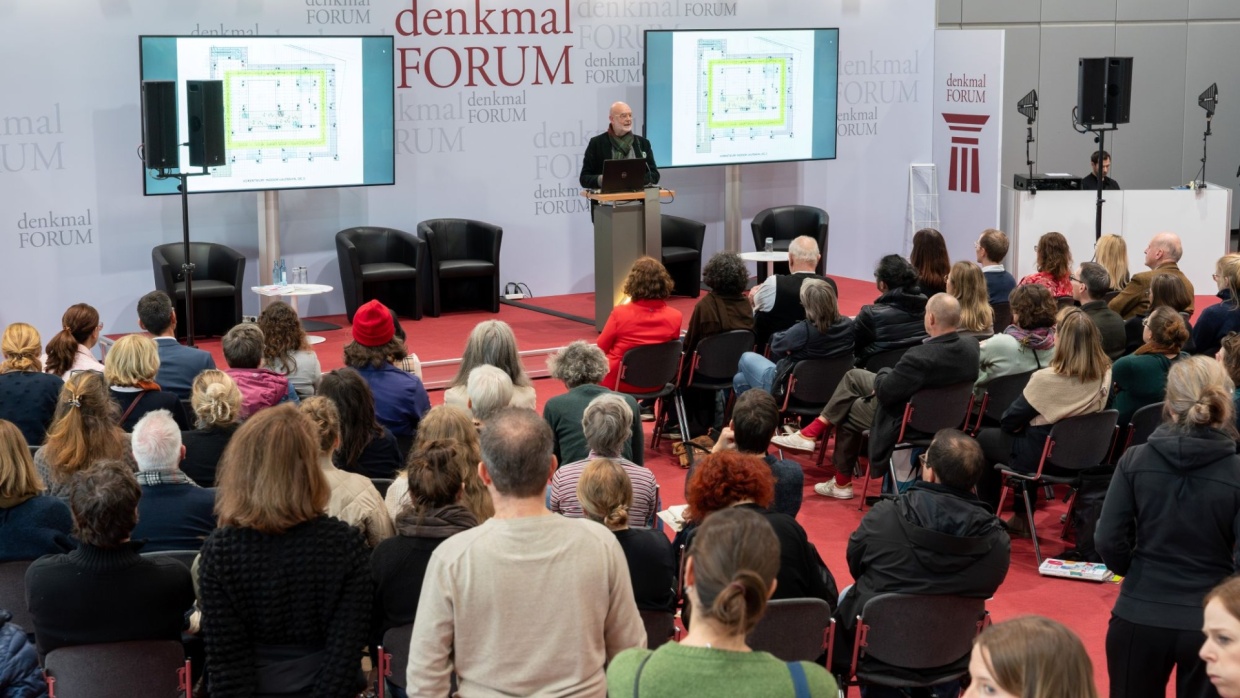
In future, research and practice will be even more closely interconnected at denkmal. Photo: Leipziger Messe
We are of course delighted that you have agreed to moderate denkmal’s first-ever opening panel. Its title will be “How Much Heritage Can We Still Afford?” Where does the word “still” in the title come from?
Heritage conservation is part of our social reality. That is what the word “still” refers to. We are living in very turbulent times. Public finances are in a difficult state, and the public sector is struggling to meet its fundamental obligations – particularly in the social sphere. Against the backdrop of enormous pressure to address some of the existential challenges of everyday life, heritage conservation can quickly slip out of focus. The question therefore addresses the need to actively engage with the value we place on our monuments and with the way we deal with them.
Short-term financial constraints must not lead us to neglect our built cultural identity, which is so significantly reflected in our monuments!
This denkmalbrief also features an interview with Volker Schweizer and Claudia Neuwald-Burg from the Fraunhofer Institute for Building Physics and the Fraunhofer Information Centre for Planning and Building. They strongly emphasise that historic building fabric in listed buildings is also an economic factor – because it attracts people, and people want to spend time there and consume there. Why, in your view, do two researchers have to emphasise this point so strongly when it seems so obvious?
I think it is important for people working in the field to speak up and consciously and clearly address things they themselves observe. To me, this is a very natural connection and a characteristic of all experts. If, for example, you talk to Jürgen Klopp, he will tell you that football is the most important thing in the world. Football, however, does not necessarily need Jürgen Klopp to attract fans, because it is deeply rooted in our everyday culture and has a strong presence in the media. For us, it is different. In heritage conservation, we basically need lots of Jürgen Klopps. Our task is to raise society’s awareness of heritage conservation issues and the value of our monuments. Appreciation does not happen automatically. It does not happen on its own. It is an important task for everyone involved in heritage conservation to stand up for the value of the field and to make its potential visible in everyday practice.
What my colleagues may also have been referring to is the fact that the current political debate around construction focuses heavily on speeding up procedures and on the challenges of housing construction. The focus is often specifically on new construction. But if we take existing buildings and their diverse potential for creating identity and social cohesion into account, that is where the much greater leverage lies – particularly in the context of a society undergoing structural change and increasingly scarce resources. These issues are often far too low on the political agenda – completely unjustifiably.
Finally, denkmal is a trade fair driven by passion. So, what do you enjoy most about denkmal?
What I enjoy most is direct contact with people at the trade fair. From my perspective, direct exchange is at the heart of any trade fair. We go there to meet curious people, to gather information and be inspired, but also to show what we can do.
I think denkmal in Leipzig is in exactly the right place in many respects. Leipzig is the largest metropolitan area in central Germany and has a tradition of more than 800 years as a trade fair city. When I travel, I rarely meet people who do not know where Leipzig is. Many people reflect their own positive perceptions and memories of the city in our conversations. Some even rave about the city, its openness to the world and its quality of life.
For my interdisciplinary team of 20 at the FLEX.institut at HTWK Leipzig, denkmal in Leipzig is exactly the right place because it gives us an opportunity to raise the visibility of our research. In our projects relating to heritage conservation, our application-oriented approach is geared towards developing solutions for dealing with our monuments and existing building stock in a way that ensures they can be carefully preserved and remain usable for many years to come.
In doing so, we make an important contribution both to social cohesion and to climate protection. If we succeed in achieving this, then every denkmal is always worth another visit to Leipziger Messe!