


News
News
The colours of Protestant Baroque in a Jena crypt – and online
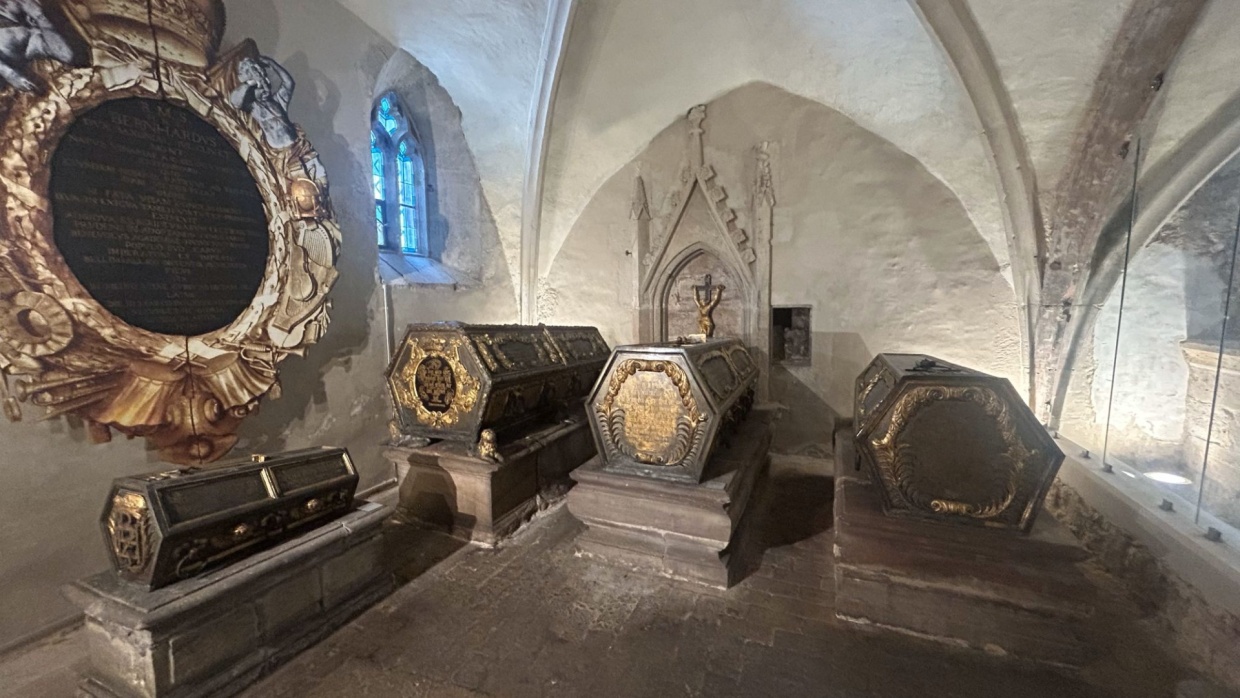
Four Baroque coffins stand in the princely crypt of St. Michael’s Church in Jena. They tell the story of a ruling family that governed Saxe-Jena for just 18 years, of Protestant burial culture and of an arson attack dating back to the GDR era. In recent years, the coffins have undergone a restoration process and, beyond that, have been digitally documented. The digital colour reconstruction shows just how magnificent burials could be in Baroque Jena – a city that sought to emulate Versailles at the time.
A ruling dynasty that existed for just 18 years – and yet had such lavish coffins made? They stand in the princely crypt of St. Michael’s Church: the four tin coffins of the Saxe-Jena family. One of them belongs to Johann Wilhelm of Saxe-Jena. The last male descendant of the house died in 1690 at the age of just 15. Two years earlier, he had begun studying at the University of Jena and, as sovereign, had simultaneously taken on the position of rector of the university.
With his death, the House of Saxe-Jena became extinct.
Today, the coffins are not only witnesses to this brief episode in Jena’s history. They also provide insight into a period when social rank and religious beliefs were expressed directly in the design of burial sites. And they tell their own eventful story.
A Little Versailles in Jena
Why were such elaborate coffins made for a ruling family that reigned for such a short time? The answer also lies in the self-image of the House of Saxe-Jena. Duke Bernhard of Saxe-Jena had married the Duchess of Trémouille. He had met her during a several-year stay at the court of the Sun King Louis XIV in Versailles. Together, they worked to establish a kind of Little Versailles in Jena. Culture and theatre were promoted, and the city was intended to gain greater significance as a cultural centre. Weimar – the actual cultural centre of the region – was left behind during this period.
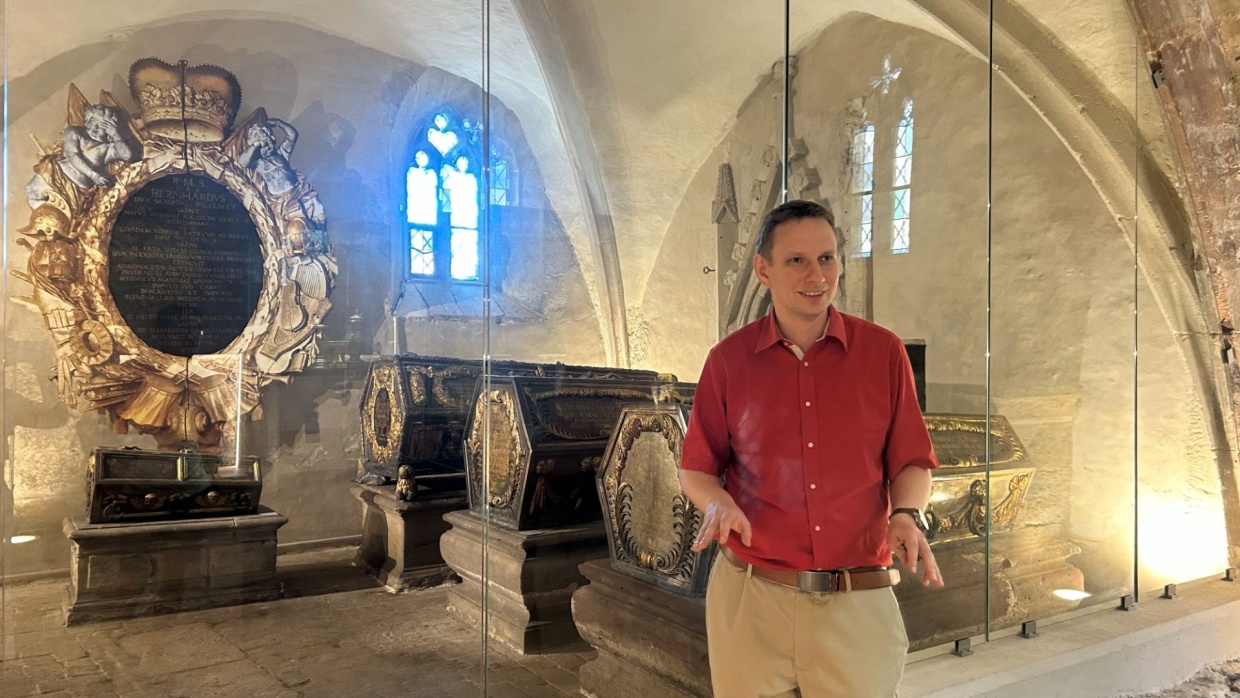
An expert on the Jena crypt – Dr Enrico Paust
This ambition was financed through debt and the Duchess’s dowry. The elaborate coffins could also be created thanks to these resources. Dr Enrico Paust from the Chair of Prehistoric and Early Historical Archaeology at Friedrich Schiller University Jena scientifically accompanied the restoration of the coffins and has researched Baroque burial culture. He explains that the coffins did not merely serve as containers for the dead. They also took on the functions otherwise performed by tomb slabs and epitaphs – namely, carrying inscriptions commemorating the deceased.
This reveals a particular feature. Normally, these three elements of a tomb are separate. In Jena – as in other princely crypts of the period – all three functions were combined in a single object: the coffin. The role of epitaphs, incidentally, can be traced back to the Protestant understanding of death. Martin Luther described death as an “eternal sleep”. The dead were not meant to disappear completely from people’s memories. Epitaphs therefore provided more detailed information about the life of the deceased. In some cases, the living even took care of their own memorials and decided what should later be written on their graves.
A coffin with a story of its own
And indeed, the story of the coffins did not end with the burial of Johann Wilhelm of Saxe-Jena – although not in the way one might expect. Shortly after the Second World War, several gilded decorative discs made of tin were stolen. This left a hole in the coffin. In 1958, unknown perpetrators used the opening to introduce burning phosphorus into the tomb. The wooden inner coffin was severely damaged, while the outer tin coffin also suffered damage. Researchers opened the coffin, extinguished the smouldering fire and removed parts of the inner coffin and human remains for examination.
The obvious question is: why would anyone set fire to the grave of a young duke more than 250 years after his death? For Dr Enrico Paust, the incident must be seen in the context of the wider treatment of princely crypts in the GDR. In many places, crypts were cleared out, inventories sold and human remains cremated. In Jena, the damage was limited to a single coffin – a comparatively fortunate outcome.
Almost 70 years later, the project revealed another surprise. When examining the inside of the coffin, the researchers discovered that the human remains removed in the 1950s had never been returned. Instead, their colleagues at the time had left behind a kind of message in a bottle: a note containing the examination results and information about where the remains had been stored.
What the surface reveals
The most recent work on the coffins involved several interconnected steps: examination, restoration and – most intriguingly – digitisation. X-ray fluorescence analysis was among the methods used for the scientific examination. This non-destructive technique can determine the composition of inorganic materials. In the case of the coffins, the materials analysed provided clues about their original colouring. Depending on how long it takes for the X-ray beam to be reflected by the metal and at what intensity, it is possible to determine which material is present – and therefore what colour it must originally have been.
The original white-gold and silvery shimmer of the coffin has in fact been lost. Dr Paust describes its current appearance as rather sombre – quite the opposite of what the Protestant ruler would have intended. However, the coffin can still be viewed in its former splendour, because its original colouring has been digitally reconstructed.
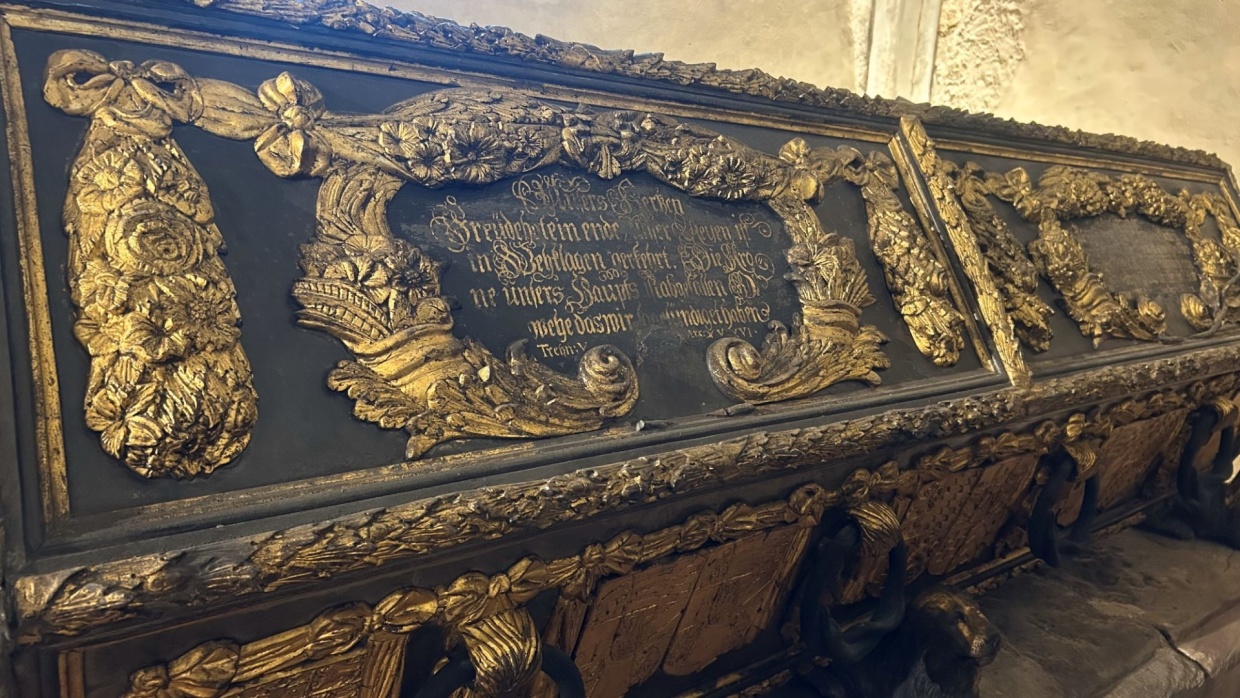
Coffin and information panel in one – the coffin of Johann Wilhelm of Saxe-Jena. Photo: Katarina Singer
The heavily damaged inscription on the lid could also largely be reconstructed. To do so, the researchers created an alphabet based on the better-preserved inscriptions on the sides of the coffin and used it to reconstruct the text, which was already known from a transcription. Around 98 per cent of the reconstruction is considered certain. Remaining uncertainties concern mainly damaged or missing sections of the inscription.
Digital conservation
For Dr Paust, the 3D digitisation serves two key purposes. First, it allows the public – whether specialists or simply people with a general interest – to gain an impression of the coffin and, with it, of the burial culture of the period. Secondly, digitisation has scientific value as documentation. The coffin was digitally recorded before, during and after restoration. This makes it possible to track how its condition has changed – and continues to change today. For example, so-called efflorescence, deposits on the surface, can be monitored. These are linked to previous cleaning measures in which hydrochloric acid was used. If similar changes occur again after restoration, the digital documentation can be used to determine whether they were already present in the same location or whether a new pattern of damage has emerged. In the latter case, changed environmental conditions could be the cause, requiring urgent corrective measures.
This possibility is highly significant. Restoration cannot simply bring the ageing process of a material to an end. Corrosion can be slowed down, but generally cannot be stopped completely. The more important it therefore is to document the condition as precisely as possible.
From coffin to monument
Many historic coffins in central Germany were damaged during the GDR era. Some were damaged by arson and looting, while others collapsed over time. Mechanical reshaping can then be extremely difficult or very costly.
Digitisation, by contrast, can document even such a condition or virtually restore an object to an earlier form while preserving its actual state. Dr Paust sees considerable potential in the project – which involved, among others, the company digitus.art, specialising in 3D visualisation – for heritage conservation as a whole. What works for a coffin can also be applied to other objects and even to buildings. Rooms can be digitally recorded and subsequently made virtually accessible, even if a building can no longer be preserved at some point in the future.
Digitisation also offers another major advantage: it makes greater accessibility possible. People who cannot descend into the crypt themselves for various reasons can still explore it. The coffins can be viewed online or, in the future, via a media station in the church or with VR glasses.
The question of the original
Without the digital twin, it would probably be much more difficult for a wider public to engage with questions of heritage conservation. How does the original change? Which of the different states an object has taken on over the centuries should we actually restore today? Where are the limits of what humans can achieve?
The coffins in Jena raise these questions – and have found an answer of their own. Anyone who wants to explore the digital reconstruction can find the result on the digitus.art website.
Digitisation of the coffin in its 1690 state and in its current, restored state