
News
News
Transformations in heritage conservation – a conversation with Alf Furkert ahead of the VDL Annual Conference in Leipzig
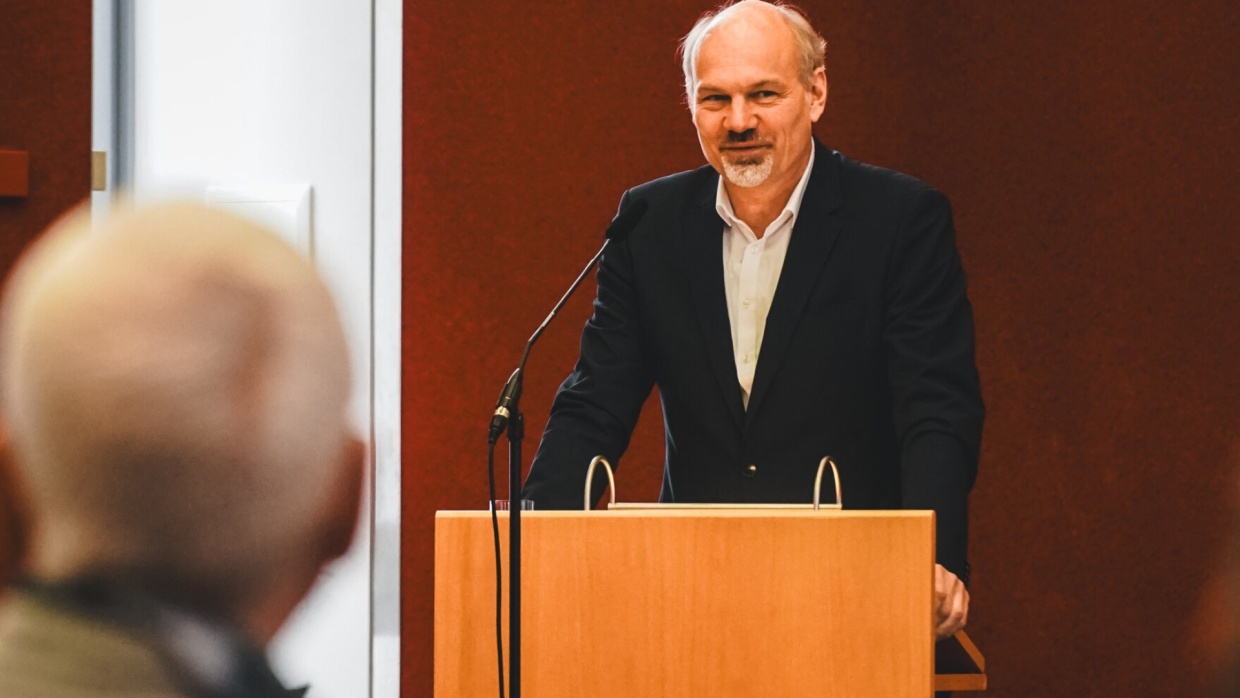
From 8 to 10 June 2026, the Association of State Heritage Offices in Germany (VDL) will hold its annual conference in Leipzig. The focus will be on current transformation processes, conflicts and opportunities within heritage conservation. Alf Furkert, Saxony’s State Conservator and Head of the State Office for Heritage Conservation in Saxony – and, last but not least, a member of the advisory board of denkmal – offers insights into the conference themes, the objectives of his office in times of change, and the future perspectives of heritage conservation.
Mr Furkert, this year’s annual conference of the Association of State Heritage Offices in Germany (VDL) is titled “Transitions. Transformations in urban and rural areas. Challenges for heritage conservation”. What major changes are currently taking place in the field of heritage conservation?
We are dealing with a wide range of transformation processes. These extend not only 30 or 35 years back to the period following German reunification and the peaceful revolution, but even further – for example in relation to coal mining and large-scale landscape transformation. At present, however, we are also witnessing a shift in the understanding of heritage conservation itself.
After decades of intensive restoration work, some people have the impression that much has already been accomplished. Younger generations often lack a direct sense of how severe structural decay once was. As a result, one occasionally hears the question: “Why do we even still need heritage conservation?” Yet the answer is very clear: we absolutely do need it. A considerable proportion of cultural heritage sites remain unrestored or have not yet found a new use. At the same time, decay and development pressure continue. Heritage conservation is therefore by no means complete – nor ever will be.
Every period of transition also creates opportunities for change. What objectives have you set for the Saxon State Office?
Transformation has sharpened our awareness of the potential of our built heritage. Many buildings, particularly industrial sites, are no longer being used for their original purpose. This creates challenges, but also enormous opportunities for adaptive reuse.
Leipzig offers excellent examples of this: former industrial sites and large commercial buildings have successfully been transformed into residential, office and cultural spaces. Our task is to support these processes. We document the original fabric and former use of buildings and advise on new concepts: what is compatible with heritage conservation? Where do we need to take a closer look? And how can new uses be enabled without compromising historical value?
Perhaps you could give us a brief overview of the conference programme. At first glance it appears highly diverse, even including events outside Leipzig. What themes will be covered?
We deliberately designed a very broad programme while at the same time trying to remain closely connected to the monuments themselves. That is why there is always a strong link between excursions and workshops: what participants see on site is then discussed and explored further in professional depth afterwards.
In total, we are offering twelve thematic sections – ranging from inner-city development potential and post-mining landscapes to reforestation, the energy transition and emergency management for cultural heritage. Excursions to Chemnitz also play a role, particularly in the context of industrial heritage and developments linked to the European Capital of Culture programme.
In addition, the “90th Heritage Conservation Day” will take place on Sunday, 7 June 2026 – a public event featuring guided tours, lectures and many local participants from Leipzig.
Which highlights of the programme will you personally attend?
As the hosting State Office, we are naturally involved throughout the conference. One central moment will be the opening plenary session, which will include several lectures deliberately extending beyond the traditional scope of heritage conservation and examining transformation processes from other disciplines.
For example, we will hear a lecture on the “genetic journey of humankind” by Professor Johannes Krause from the Max Planck Institute in Leipzig. On the evening of the third day, we will gather at Hubertusburg Palace, where all excursions will conclude with a reception hosted by the Free State of Saxony.
Beyond that, I will be present at various events throughout the conference and hope to welcome many of the approximately 400 participants travelling from across Germany.
Where do you currently see a need for support within heritage conservation – and from whom?
If I could wish for one thing, it would be greater understanding of heritage conservation as a shared societal responsibility. There are many highly committed owners, associations and initiatives dedicated to architectural culture. At the same time, however, heritage conservation is sometimes perceived as an obstacle or as something that complicates investment.
In my view, these oppositions are often exaggerated. Fundamentally, many people are proud of their built heritage – they simply do not always recognise the effort that was and continues to be required in order to achieve and maintain its current condition. This is precisely where we need more dialogue and greater mutual understanding.
What significance does denkmal have for you in this context?
For us, denkmal is an absolutely central event – a true industry gathering in the best sense of the term. It brings together experts, craftspeople, public authorities, planners and an interested public. This combination makes it especially valuable.
It is not only a trade fair but also a place of public engagement and exchange. Time and again, it is described as a family reunion. From my perspective, I can only agree with that characterisation. For heritage conservation as a whole, it is therefore an important point of orientation every two years.