
News
News
Unearthed – what happens next?
From preliminary investigation to public engagement, an archaeological find passes through many stages. At denkmal’s new Archaeology exhibition area, these stages will be brought to life. In conversation with Svenja Partheil, President of CIfA Deutschland, and Christoph Genzel, soil scientist and host of the Soilcast podcast, we explore what visitors can expect. In this article, they explain how a find can be professionally safeguarded yet still be lost to society, how this problem can be addressed – and even how soil can be made audible.
Soil has many stories to tell: of past landscapes and climatic conditions, vegetation and human land use, settlements, battles and troop movements. For Christoph Genzel, the link between soil science and archaeology is therefore clear: “Soils preserve the history of a landscape, whether in the form of information about vegetation and climatic conditions in past centuries or about cultural heritage.” In addition to their physical and chemical functions, Genzel highlights the archival function of soils. Through the Soilcast podcast, he and his team raise awareness of the many facets of soil and its wide range of uses.
Before the first spade breaks ground
But how does a site become an archaeological excavation site? “It all begins with the preliminary investigation,” explains Svenja Partheil, President of CIfA Deutschland. Existing data is evaluated and supplemented by further research, such as geophysical surveys or the analysis of aerial photographs. The results are compiled into expert assessments of a site’s archaeological significance.
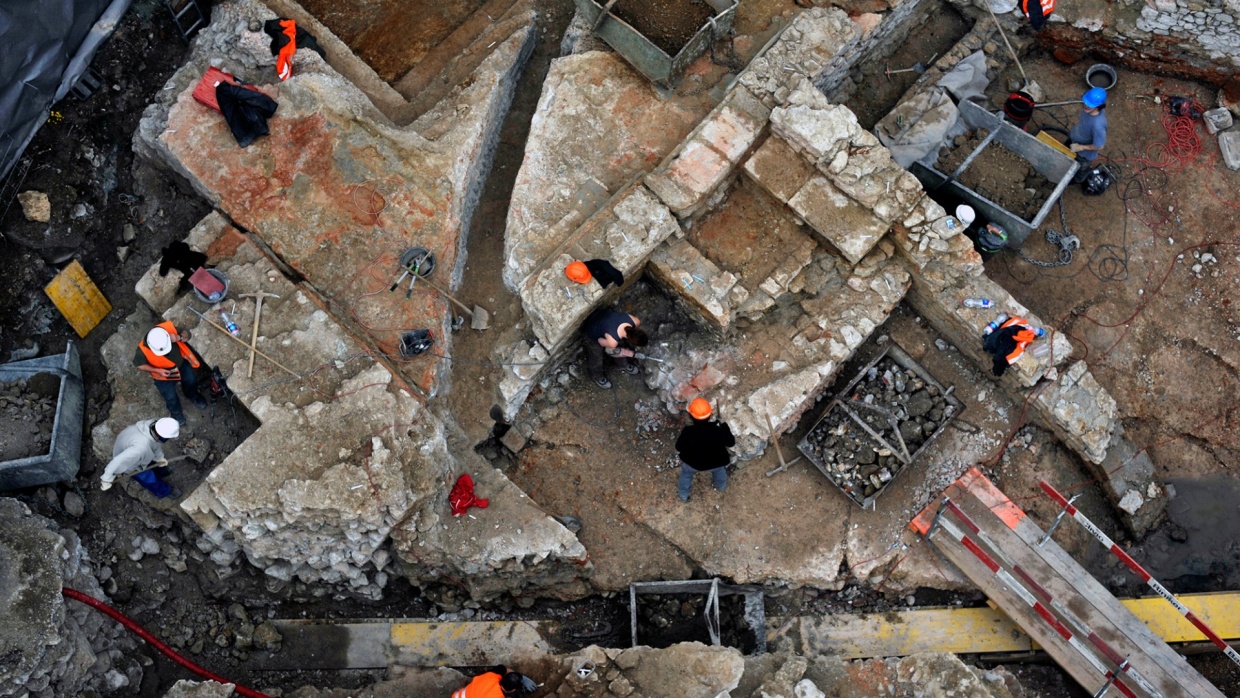
If construction is planned on the site, excavation follows. The archaeological monument is carefully dismantled under controlled conditions and fully documented. This is a critical step because it cannot be reversed: “What is not documented is lost,” says Partheil. Recovered finds are inventoried and given initial conservation treatment. This can involve anything from washing fragments of pottery to sealing delicate metal finds in packaging with oxygen absorbers. At the same time, the excavation record is created, documenting all features in the ground that cannot be removed, such as entire walls or pits. The recovered finds and completed documentation are then handed over to the heritage authority.
This marks the end of the standard procedure. The results can now be published and made accessible to a wider audience.
Professionally safeguarded, but lost to society
There is, however, one major caveat: “To be honest, many finds never reach this stage of public engagement,” says Partheil. Although they are documented and placed in storage, they are rarely restored, published or presented to the public. Whether these additional steps take place depends on whether they are commissioned and funded, or whether state heritage authorities or museums are interested in working on the find in their own conservation departments.
Partheil regards this as one of the most important tasks for the years ahead. If a supermarket or an energy transmission line is later built on an investigated site, the people living there should be able to learn what once stood or happened in that place. Information panels, local community features, replicas for schools or digital formats can bring the findings back to the place where they were discovered.
“A find that ends up in storage and that nobody in the local area ever hears about has been professionally safeguarded, but is lost to society,” says Partheil. In construction projects, archaeology is often perceived merely as a cost factor. Visible results, by contrast, can demonstrate that the money was well spent – and give people back a piece of their local history.
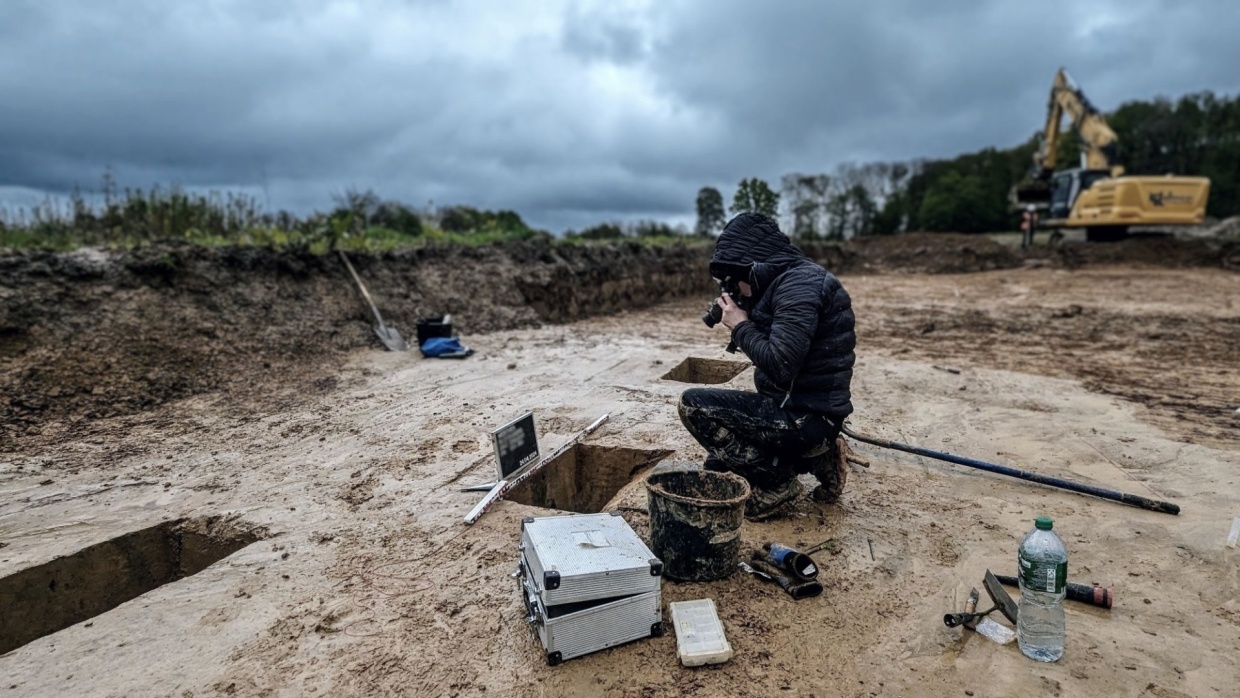
Image credit: Büro für Archäologie Neupert, Kozik & Simm GbR_Markus Hirnich
From scan to finished object
According to Partheil, almost every stage in this “biography of a find” will be represented in denkmal’s new Archaeology exhibition area: from preliminary investigation and excavation to surveying, digital recording, anthropological analysis, conservation, publication and public engagement.
SPAU GmbH, for example, will demonstrate how these stages interconnect. The company works across the entire process, from preliminary investigation to public engagement, and will showcase each of these areas. An archaeozoologist, an archaeobotanist and an anthropologist will also present their work. MICROBOX will demonstrate how high-resolution 3D scans are created. Preliminary investigations will be represented by the Büro für Bodenkunde und Geoarchäologie and by OKM GmbH with its detectors. A wide range of specialist companies from Germany will cover the excavation stage. Rubicon Heritage, a company headquartered in Ireland, will contribute its experience from there. Chiara Girotto of AnthroLab will represent osteoarchaeological analysis and carry out skeletal examinations. Beier & Beran and the DGUF will represent publication, while Soilcast will play a key role in public engagement by exploring archaeology in depth at denkmal.
When soil becomes audible
The question of how complex knowledge can be communicated accessibly is central to Soilcast. The team aims to explain scientific methods in the most approachable way possible, repeatedly addressing the question of what we gain from studying soils. Particularly in the face of growing hostility towards science, Genzel believes that this kind of communication is important.
For him, science communication does not begin with explaining, but with listening. Concerns and reservations, for example, when specific conflicts over land use arise, as they may with farmers, must be taken seriously. Genzel wants to understand how a particular viewpoint has developed. Only when the other person feels heard can a conversation begin about how both sides can support one another and move forward together.
Soilcast aims to raise public awareness of the many different functions of soil. Image credit: Soilcast, Christoph Genzel
This also applies to the expansion of the power grid – the project that first brought archaeology to denkmal. By 2048, up to 20,000 kilometres of power transmission lines will be laid underground, carrying electricity from Germany’s wind-rich north to its industrial south. To ensure that these major interventions in the soil are carried out responsibly, land use and the potential loss of protected soil functions must be assessed in advance. Interventions should be offset elsewhere, for example by removing hard surfaces and allowing natural soil formation to resume. Sites suspected of containing archaeological remains must be investigated and any features carefully documented. For Genzel, this is how grid expansion, soil protection and archaeology can be reconciled.
Genzel believes there is still considerable room for improvement when it comes to communicating this vast project to the public. What is needed, he says, is clear communication at an early stage. People must be given enough time to engage with a project and should be addressed directly. Good online resources could help.
A trade fair appearance can help too, of course. So, what does the Soilcast team plan to record at denkmal? Not everything has been decided yet, but the team definitely intends to gather voices from a variety of professions. What are their perspectives on soil, and what role does it play in their working environment? The precise plan remains open. The team will, however, bring along an offline version of its SoundMap, allowing visitors to hear what soils sound like. Beyond its ability to engage the public, this kind of acoustic soil analysis also has a very practical scientific benefit: according to Genzel, it can be used to assess the quality of life within the soil.
He hopes that denkmal will offer opportunities for dialogue, fresh ideas and new contacts, and therefore material for future episodes. With so many different perspectives on soil, he is certain: “Something worthwhile is bound to come out of it.”