
News
News
Can a book save a monument?
Without knowledge of a monument’s building history, materials and condition, it can scarcely be preserved in a way that is tailored to it. Prof. Dr.-Ing. Christina Krafczyk, President of the Lower Saxony State Office for Heritage Preservation, and Frank Kluger, Publishing Director at CW Niemeyer Buchverlage, discuss books as repositories of knowledge, the Denkmalatlas Niedersachsen, historic building fabric as a resource, and the ways digital and immersive formats will change heritage interpretation.
Dr Krafczyk, can a book save a monument?
Dr.-Ing. Christina Krafczyk: If it is a building monograph, it certainly can. It provides the essential foundation for conserving a monument. Without sound knowledge of its building history, construction phases and physical condition, conservation measures cannot be developed in a way that is tailored to the individual building. It is always helpful when that knowledge is available early in the planning process, when different interests are being weighed.
Heritage preservation is a demanding specialist field. What must a publication achieve in order to meet academic standards and still be a pleasure to read?
The range of heritage preservation is broad. Publications address the field’s core subjects, including heritage inventories and the conservation of monuments. Academic questions range from disciplinary history, building monographs, materials science, building archaeology and restoration to best-practice examples and much more. Depending on the subject, the real art lies in placing highly detailed scholarly findings in a broader context and opening up new approaches to the topic.
Printed book, e-paper or digital database: how is digitalisation changing the documentation and communication of heritage preservation?
Digitalising our formats – including the journal Berichte zur Denkmalpflege and other publications – generally gives us greater reach, more acceptance through reliable information and discoverability, and the ability to connect with the questions of the present. In particular, our online service Denkmalatlas Niedersachsen has created an always up-to-date repository of knowledge and developed into a communications platform for citizens, specialists, planners and heritage owners. It makes Lower Saxony’s heritage landscape accessible as a whole, while also allowing in-depth exploration through individual examples. This dynamic combination of an informative overview of the stock, well-founded heritage interpretation and an object portal with search functionality makes the NLD’s Denkmalatlas a sustainable online instrument for heritage preservation.
We believe that this format can help make the public and policymakers more aware of existing qualities – of what defines Lower Saxony’s building culture – and carry them into the future through qualified advice. And of course, with a digital format for documentation and communication such as this, we also hope to counter the steady increase in the average age of people interested in heritage and to reach younger generations, inspiring them to engage with historic building fabric.
Which topics are particularly engaging your readers at the moment, and does this reflect a changed understanding of heritage preservation?
One issue of particular interest is the relationship between heritage preservation and climate action. Long seen as opposites, they are increasingly understood as a synergy. Central to this is the idea that cultural heritage is not part of the problem, but part of the solution: historic buildings already embody a form of resource conservation through their “embodied energy”, longevity and repairability – qualities that new construction has yet to attain.
This shifts the understanding of heritage preservation away from the mere safeguarding of historic fabric towards an active role as a provider of knowledge and experience for sustainable, climate-appropriate building. There is also a noticeable growing interest in holistic perspectives that look beyond individual façades or components to neighbourhoods, life cycles and overall energy balances. Overall, this reflects a change of perspective: looking back to traditional building knowledge is no longer seen as backward-looking, but as a forward-looking contribution to the climate debate.
Mr Kluger, CW Niemeyer Buchverlage in Hameln has exhibited at denkmal for many years. What value does direct exchange with specialists have for a publishing house whose daily work is primarily concerned with texts and books?
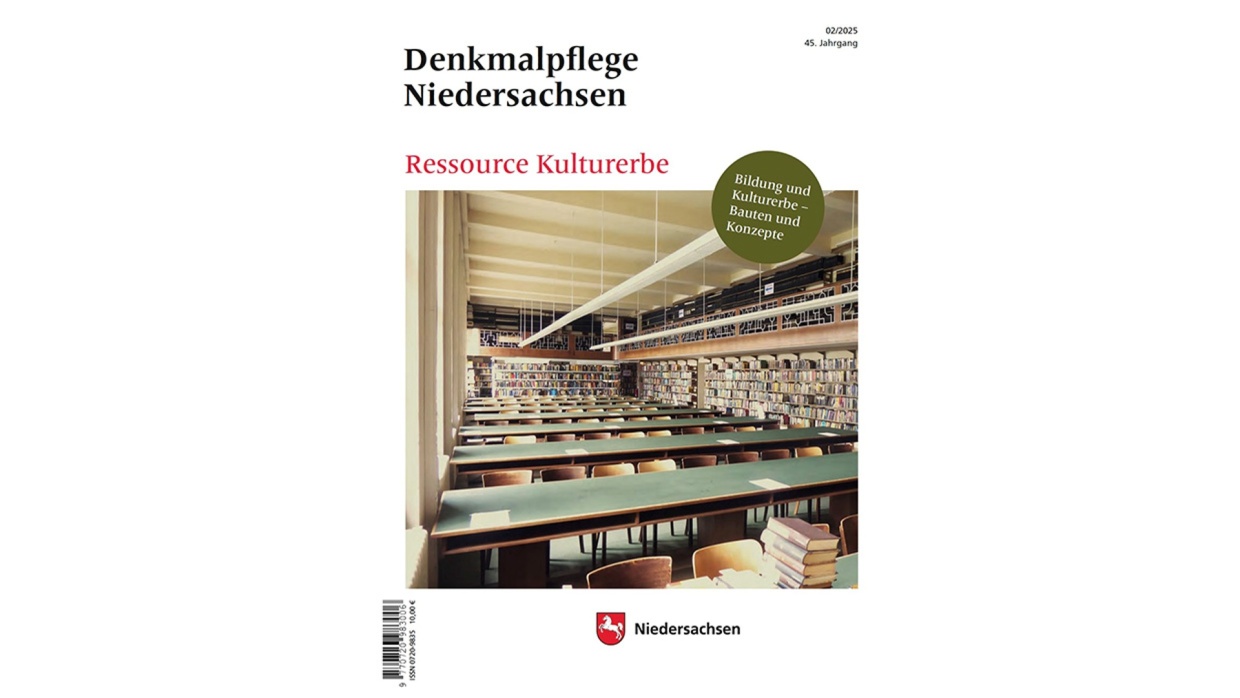
Frank Kluger: We have been represented at denkmal since 1998 and present the journal Berichte zur Denkmalpflege in Niedersachsen here every two years. It is produced, editorially managed and published by the Lower Saxony State Office for Heritage Preservation in Hanover. Direct exchange with specialists and the editorial team at the State Office enriches us in terms of content – our publishing programme, covering regional titles from the Weser Uplands, illustrated art books, history, fairy tales and legends, and novels, complements heritage preservation very well. It is also indispensable to producing the journal smoothly, so that editorial work and authors’ contributions, manufacturing and distribution all mesh effectively.
What will you bring to denkmal 2026 in Leipzig, and which new publication would you especially like to highlight?
Kluger: We always bring a broad selection of copies from different years as well as various issues devoted to Lower Saxony’s key themes, such as historic garden preservation or the 1920s, which visitors can browse at our stand. All fields of heritage work are represented, especially architecture, archaeology, architectural history and art history. The latest issue, published in May 2026, will also be at this year’s denkmal; it contains informative and engaging articles on research into ecclesiastical architecture in Lower Saxony. Alongside the copies for sale, our publishing website also provides numerous e-paper editions free of charge and conveniently accessible on all devices. So a visit is well worthwhile!
Looking to the future, how will we document and share knowledge about monuments in ten or twenty years?
Kluger: Digitalisation, AI and immersive technologies are advancing at such speed that the documentation and sharing of knowledge about monuments – especially for the general public and interested laypeople – will change immensely. The experiential quality of a monument may move even more to the centre, embedded in its historical dimension and made interactive, accessible and immediate, for example through virtual journeys through time. This offers the chance of continually growing interest and appreciation among the public, along with the desire to preserve as many monuments as possible in their original fabric.