

News
News
From Greenland to Armenia: Europe’s crafts come to Leipzig
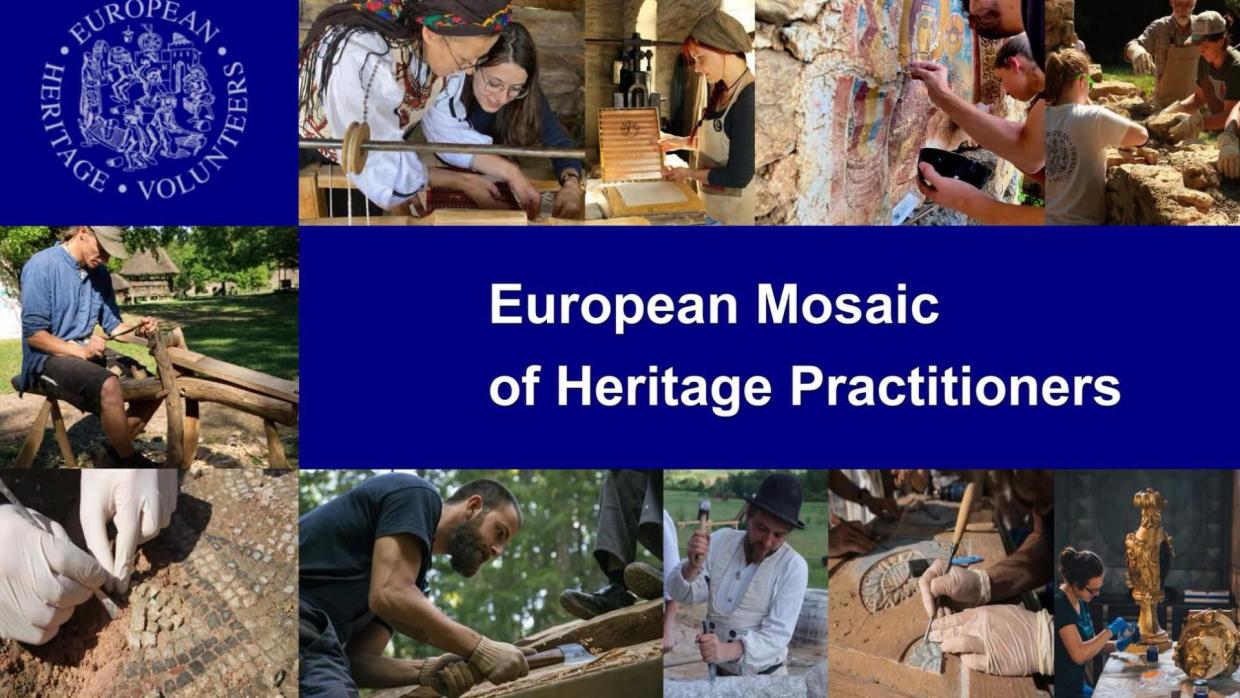
Ten practitioners from ten European regions will use a mosaic at denkmal to show just how diverse and vibrant cultural heritage can be. The initiative was launched by Bert Ludwig of European Heritage Volunteers. In this interview, he explains why traditional techniques – from thatching to black embroidery – are under threat, and why passing them on is more important than ever.
Mr Ludwig, what is behind the “European Mosaic of Heritage Practitioners”, and how did the idea emerge?
The idea for the European Mosaic of Heritage Practitioners arose because, in our heritage work in many European countries, we observe the same phenomenon: traditional craft techniques that shaped a region for centuries are increasingly being forgotten.
There are several reasons. Labour-intensive techniques cannot compete with modern, less labour-intensive methods at a time when personnel costs are often the largest cost factor. Traditional, frequently natural materials used in earlier times often cannot meet market expectations of uniformity and warranty. And techniques that use natural or nature-based materials generally require regular inspection, care and maintenance – at odds with the widespread desire to buy a product that will last “forever”. At the same time, the positive qualities of these techniques – the individuality of handmade objects, their resilience in changing climatic conditions and, with appropriate care, their durability – are often not valued sufficiently.
There are also challenges such as demographic change, migration from rural areas and the loss of regional identity. As a result, when the people who master traditional techniques – and acquired their knowledge and skills from previous generations – retire or pass away, they often have no successors.
These developments can be observed throughout Europe: they are somewhat more advanced in the west and north, and are occurring with a certain delay in the south and east.
For these reasons, we initiated the Mosaic of Heritage Practitioners. It brings together ten practitioners from ten European regions – from Greenland to Ukraine, from Lithuania to Armenia – who demonstrate their respective crafts in practice. We are convinced that this makes it far easier to spark interest than texts and photographs alone could.
Why is the image of a mosaic especially apt for describing commitment to cultural heritage in Europe?
The image of a mosaic best conveys the many small elements and facets of European cultural heritage, which nevertheless come together to form a shared and richly varied picture.
What forms of cultural heritage are the participating organisations and countries bringing to Leipzig?
The countries, institutions and organisations involved show how diverse European cultural heritage and its craft traditions are.
Armenia will present the traditional art of making the country’s characteristic stone stelae, khachkars; the Ore Mountains will present traditional thatching; Lithuania the carving of wooden carnival masks; and Romania and Ukraine traditional regional embroidery techniques.
Craft-based conservation techniques are another important aspect, including the restoration of Orthodox icons in Serbia and the conservation of Roman and early Christian mosaics in North Macedonia.
Finally, the programme presents techniques that had been forgotten over time but are now being revived: extracting natural pigments from coloured earths and stones in Austria; producing paint from whale and seal oil in Greenland; and research in Bavaria that makes it possible to produce building materials similar to Roman concrete and Renaissance terrazzo.
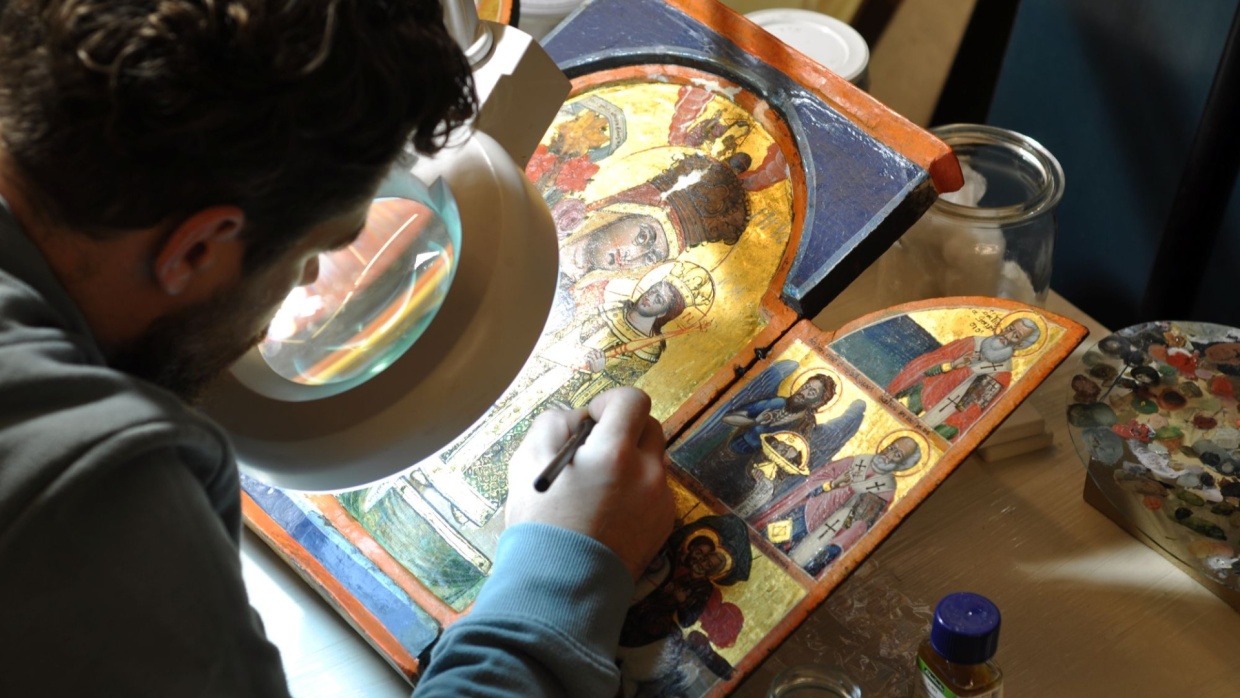
Icon restoration, © European Heritage Volunteers
A particular focus is on countries whose heritage work has so far received less international attention. What new perspectives can these actors bring to the European debate?
Public perception of European cultural heritage is markedly unbalanced. Based on the prevailing Western European canon and understanding of art history, and a focus on “high culture”, the heritage of countries such as Italy, France and Germany receives far more attention than that of other countries. The term “Europe” is also often mistakenly equated with the European Union.
Many aspects are overlooked. More than 90 per cent of cultural heritage is not made up of “landmarks of art history” or Instagram-ready sites, but of monuments in small towns and villages that contribute significantly to regional identity. In the past, not only Western European centres such as Rome, but also more easterly centres such as Byzantium, had a substantial influence on artistic and building traditions. And in regions farther from the epicentres of artistic, technical and later industrial development, local and regional traditions have often survived more strongly than in places close to those centres.
For traditional craft techniques, Europe’s “peripheral” regions are particularly important because local and regional techniques and traditions have been better preserved there than in the centre of the continent. But they too are under threat.
The Mosaic’s focus on these countries therefore serves two purposes: to illustrate the richness of craft practices still found in Europe, and to give these endangered practices visibility beyond their regions.
Are there methods among the techniques presented that are little known or rarely encountered, even within the specialist community?
Yes. On the one hand, the European Mosaic of Heritage Practitioners presents techniques that many people would probably place elsewhere geographically – few would initially think of North Macedonia in connection with the conservation and restoration of Roman and early Christian mosaics.
It also presents techniques that are likely to be less familiar even to specialists in Central and Western Europe, such as carving khachkars from tuff stone in Armenia.
Thirdly, it presents techniques whose historical existence is known but whose specific technology had been forgotten, such as the method of producing Roman concrete established through extensive archaeological research and material analysis.
Fourthly, it features techniques that were displaced by industrialisation but are now again practised on a small scale, including the extraction and use of pigments from coloured earths in Austria and the production of paints based on whale and seal oil, optimally adapted to Arctic climatic conditions, in Greenland.
Finally, including techniques of intangible cultural heritage – such as making wooden carnival masks in Lithuania and reviving traditional techniques for producing textiles central to national and regional identity in Romania and Ukraine – offers fresh insights for people who work primarily with built heritage.
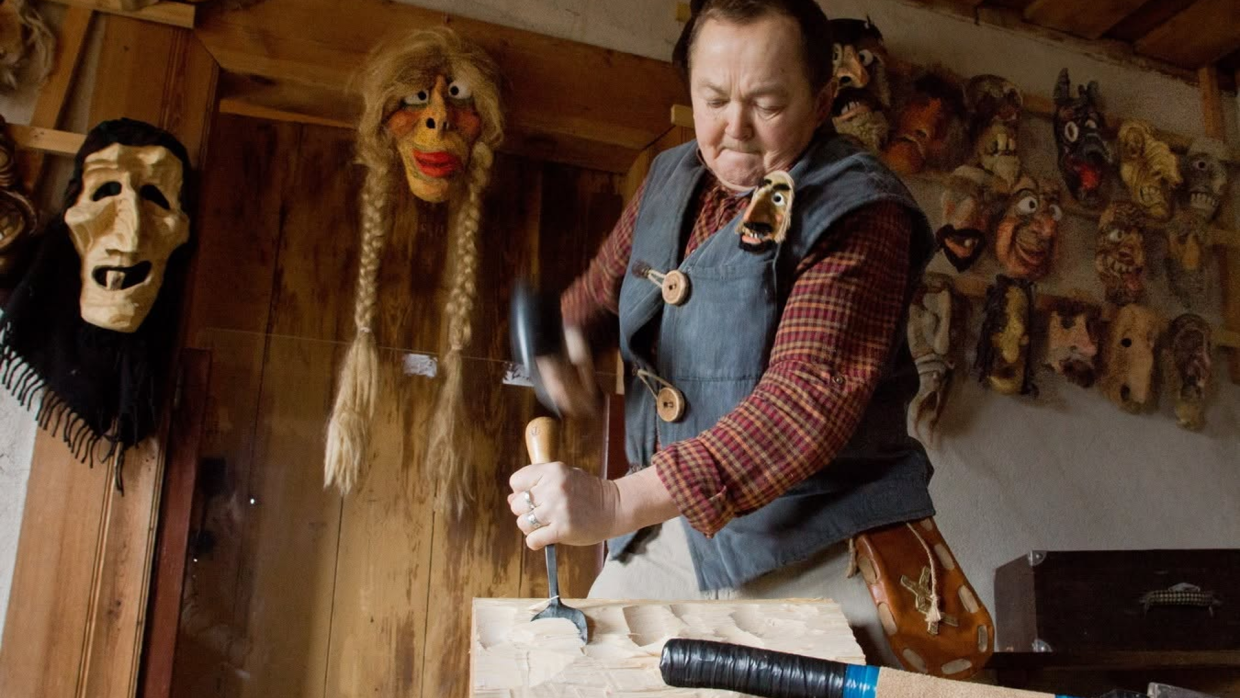
Making wooden masks, © European Heritage Volunteers
The Mosaic also presents successful examples of involving young people. What distinguishes projects that succeed in attracting the next generation to heritage preservation?
Some of the techniques presented are mastered by only a few craftspeople. Given the situation outlined above, passing knowledge and skills on to young people is fundamental. Almost all ten techniques we present face a lack of young people entering the field.
We are therefore especially pleased that Lithuania and North Macedonia will be represented by young specialists. Because younger generations need role models from whom they can learn, we are equally pleased that our two oldest practitioners – a restoration couple from Austria, both over 80 – are taking part.
Will the European Mosaic continue to grow beyond this year’s denkmal, or perhaps be shown elsewhere?
Yes. The first edition is intended only as a starting point that will spark interest in the subject. In the coming years, the Mosaic is to be expanded to include further countries, regions and techniques, and shown elsewhere in Germany and other European countries.
Which “mosaic stone”, or which of the participating initiatives, surprised you most during preparation?
As the Mosaic emerged from our network, whose partners we have worked with for a long time, none of its pieces truly surprised us. I would perhaps rephrase the question: “Which mosaic piece are you happiest to have taking part?”
One is the participation of the master from Armenia, who has worked with khachkar-making techniques for a long time, because Armenia’s very old and rich culture is not especially well known here.
The other, seen from a regional Saxon perspective, is the presentation of traditional thatching by the Ore Mountains Open-Air Museum Seiffen. This technique was once widespread in our region but is now scarcely practised. If its presentation at denkmal 2026 helps bring it back into public awareness and generates support for re-thatching the building at the Ore Mountains Open-Air Museum that originally had a thatched roof – ideally with hands-on help from European Heritage Volunteers – that would be a major gain for preserving a traditional craft technique once widespread in Saxony but now endangered.