


News
News
“Knowledge can be accessed. Skill has to be acquired.”
One thing becomes particularly clear in this interview with Ralph-Uwe Johann, Managing Director of longstanding denkmal exhibitor Deffner & Johann: in the age of artificial intelligence, the value of practical skill has increased many times over. AI is not the first far-reaching change the company has addressed.
Mr Johann, your company, Deffner & Johann, was founded in 1880 and is now run by the fifth generation. How does a company preserve its own tradition without itself becoming cultural heritage?
First and foremost, our customers decide that. A company may have an impressive history, but if its products and services are no longer needed, it loses relevance. Tradition alone is not a business model.
At 146 years, however, a company is of an exceptional age. Behind that are five generations of entrepreneurial spirit, foresight and adaptability – first three generations of the Deffner family, then two of the Johann family. That deserves respect and also creates an obligation.
In some respects, such a company certainly is part of cultural heritage. Over generations, experience, skills, business relationships and a particular corporate culture have developed. These values need to be preserved without being fossilised.
Tradition and innovation are by no means opposites. On the contrary: we preserve our tradition by continually aligning our offering with our customers’ needs.
Many traditional materials are scarcely manufactured by industry today. What does it mean for heritage preservation that you continue to make such products available?
This is one of our most important tasks – and often more difficult than adding innovations to our range.
The object, knowledge of how it was made, and the materials and tools used form a triad. If one of these elements is lost, it becomes difficult to understand and preserve the others.
Many of our specialised manufacturers are small businesses caught between profitability, regulation and a lack of successors. Major industrial groups, meanwhile, barely take account of the small quantities required for conservation. As a result, proven products disappear from the market every year.
Sometimes this can be prevented. A good example is the Schläger, a special brush used for graining and marbling techniques. A customer who teaches historic painting techniques complained that a replacement brush no longer had the quality of the earlier version. Because costs had risen and long Chinese bristles were difficult to obtain, our manufacturer had switched to a mixed bristle.
The master brushmaker was genuinely pleased about the criticism. He found excellent long Chinese bristles and again made a wonderful Schläger. It is much more expensive today, but with good care such a tool lasts an entire working life.
This shows what is possible when users, specialist retailers and manufacturers speak to one another. We have a broad network of long-standing, often regional manufacturing partners who can handle small quantities and special requirements. We pool demand and mediate between those involved. But users also need to understand that products remain on the market only if they are bought. The availability of materials and methods is part of safeguarding our cultural heritage.
Restoration materials intervene directly in often irreplaceable original fabric. By which criteria do you decide what to include in your range?
Here we rely on our customers’ experience and feedback. We work closely with universities, research institutions and specialised manufacturers. Many ideas for products come directly from conservation practice.
We support open-ended research and testing. The outcome must also be allowed to show that a product is unsuitable.
Conservation science has progressed considerably over the past 25 years. The well-founded phrase, “Today’s solutions are tomorrow’s problems”, has left its mark. New materials are examined much more thoroughly for their properties, ageing resistance and long-term effects.
Division of labour also plays an important role. I am not convinced by specialist retailers who believe they should become manufacturers as well in pursuit of additional value creation. The skills are fundamentally different. We deliberately rely on long-standing manufacturer partnerships. Our partners contribute their development and production expertise; we contribute customer proximity, market knowledge and reach.
Ultimately, it is the conservator who decides whether a material is suitable for a particular object. We want to offer a sound selection for that decision.
Are there times when you recognise that an established material is no longer the best solution and that a new technology has advanced conservation?
Of course. Otherwise, we would confuse tradition with stagnation.
New materials and technologies have to prove themselves in practice. No conservator will voluntarily adopt an inferior method. But innovations can now deliver progress in several ways at once: greater effectiveness, more precise application and lower impacts on people and the environment.
One example is Propadyn, a new alternative to conventional silica gels for regulating relative humidity. Producing silica gel is very energy-intensive. Propadyn takes a different, cellulose-based approach aimed at far less energy-intensive production.
Then there are Nanorestore cleaning systems. Extensive research projects, including European-funded projects, have developed microemulsions that use a fraction of the solvents employed until now without compromising effectiveness or controllability.
Lascaux, too, has thoroughly advanced its proven heat-seal adhesives. In the best Swiss manner, it has created a new generation without toluene, using alternative, more environmentally compatible solvents.
Such developments do not always meet with enthusiasm immediately. A product suddenly smells different or behaves unusually in use. In our sector, new things are initially met with scepticism. Given the responsibility for original material, that is understandable.
But habit is not a marker of quality. Sometimes we need to leave well-trodden paths. Especially in the handling of solvents, there are enough cases of health impairment through years of occupational exposure.
If new methods work at least as well while placing less strain on users’ health and on the environment, we should not reject them simply because we first have to get used to them.
What effects do stricter regulations, changing supply chains and the limited availability of certain raw materials have on conservation?
Sustainability and the protection of the environment and health are among the great achievements of our society. I come from Schweinfurt, where the highly toxic, arsenic-containing pigment Schweinfurt Green was produced in the nineteenth century. We would rightly no longer accept the environmental and health risks associated with it today.
But we need to discuss proportionality. Conservators are specialist users who work with small quantities and under particular professional conditions. If we ignore those differences, we do not merely make conservation more difficult. We can make certain methods impossible or compromise historical authenticity.
This concerns traditional pigments, binding media and animal-derived raw materials. Often, regulatory effort alone is enough for a manufacturer to abandon a niche product.
Germany in particular tends to perfect regulations until they become impractical. Bureaucracy was long a stabilising force in our economy. Today, in public authorities and increasingly in companies, it can sometimes become an end in itself.
I often have to smile when I am told what is supposedly impossible because of the EU. My business partners in Denmark, the Netherlands and Portugal often approach the same European framework more pragmatically. And as far as I know, those countries are in the EU too.
We do not need less responsibility; we need more judgement. For Deffner & Johann, this means considerable additional work to secure supply chains, find alternatives and support manufacturers. Our broad network helps us. Good environmental protection and good heritage preservation need not be opposites.
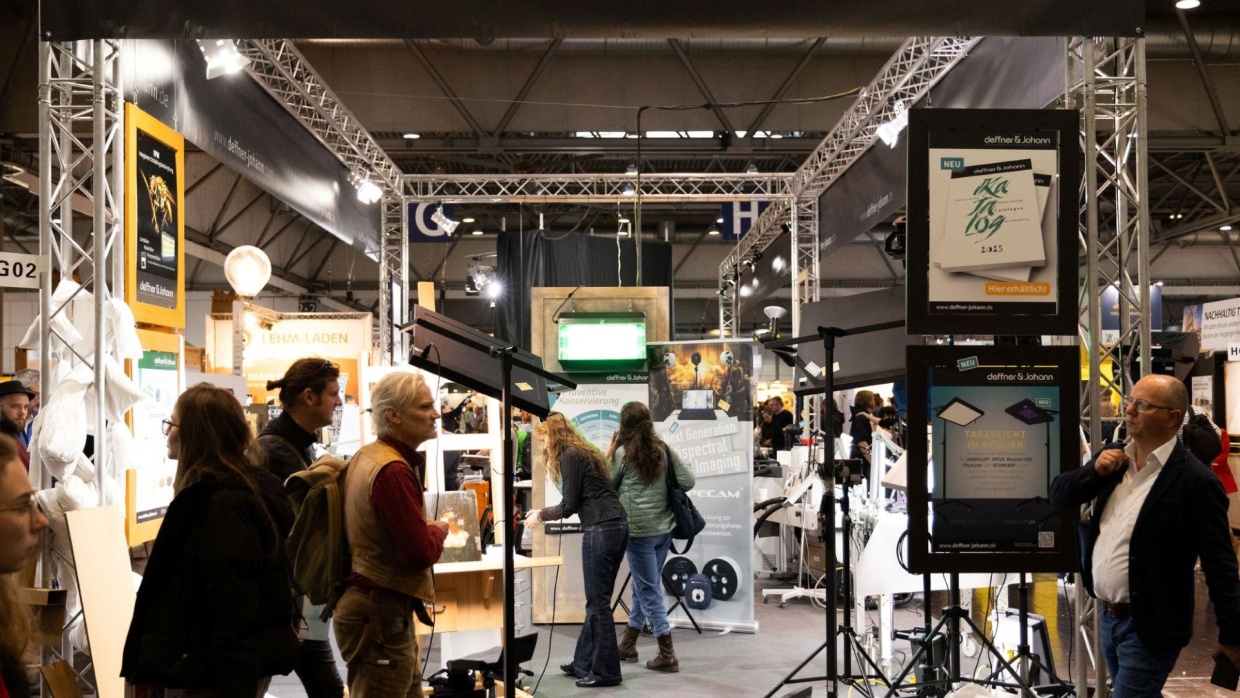
The Deffner & Johann stand at denkmal, © Henrik Malmqvist
You have exhibited in Leipzig since the first denkmal in 1994. How have the fair and the profession’s key issues changed from your perspective?
We took part in 1994 at the old Leipzig trade fair grounds and have not missed an event since. At that time, German reunification had taken place only a few years earlier. The need for heritage work was enormous, especially in the eastern German states. Today, we are concerned with sustainability, the availability of resources, scientific methods, digitalisation and artificial intelligence.
Our own presence has also changed again and again. We bring new manufacturers, technologies and ideas to Leipzig. For us, the fair has long been more than a product exhibition.
Interestingly, we still produce a substantial printed catalogue every two to three years. Our customers value this compendium highly. You leaf through it, discover connections and come across products you were not even looking for. It is a different way of finding information. Many customers also value its tactile quality.
Leipziger Messe has accompanied this change in exemplary fashion. The team is exceptionally committed and service-oriented. MUTEC has usefully broadened the offer. While other specialist fairs have disappeared, denkmal and MUTEC have developed successfully.
We have been able to contribute to that. In 2004, we received the denkmal Gold Medal for our range, and again in 2018 for promoting expert exchange and for our presentation. These two awards also reflect the evolution of our presence at the fair. We are proud of that. After all, a trade fair lives through the people and companies that fill it with content.
You call denkmal the industry’s family reunion. What can personal encounters in Leipzig achieve that cannot be replaced by an online shop, video conference or specialist publication?
Come to our stand!
With our “Expert to Expert” format, we created a small marketplace there many years ago. Manufacturers, developers and users meet directly. They show and discuss solutions, talk about innovations, but also openly about limitations and disadvantages.
No online shop can replace that. In our sector in particular, you have to experience materials – what does good linseed-oil paint smell like, how does it spread? You need to try tools – how do you attach a mechanical anti-theft device to an ornamental frame? And you need to watch people at work – how are nanorestore® microemulsions applied to remove varnish, or historic lettering cleaned with soft-particle blasting?
And of course it is a family reunion. Many people have known one another for decades, former fellow students meet again and new contacts are made. It is not as if everyone always agrees – as we know, that is not the case in families either. But there is a shared passion. And, quite simply, it is a pleasure to see these people again in Leipzig.
As deputy chair of the denkmal advisory board, you support the fair beyond your own presence as an exhibitor. Which issues should it address more strongly in the future?
I believe we are currently experiencing a fundamental social transformation. For decades, we have driven the transition to a knowledge society. Scientific findings, documentation and access to information have become ever more important. This was an enormous advance in conservation too.
Artificial intelligence is now changing the value of knowledge. Information is available on an unprecedented scale. Everyone can access it on a smartphone. The cost of access to knowledge is falling dramatically because supply is virtually exploding.
But knowledge is not skill.
Retrieving information is one thing. Classifying it correctly and turning it into professionally responsible action is something entirely different. An AI can explain how a historic glue is made. But it cannot itself judge how a pre-damaged, centuries-old surface will behave under a tool.
For this reason, skill, experience and practical competence become more important, in my view, with every new AI development. The combination of theoretical knowledge and practical application has always distinguished craft and academic training in German-speaking countries. We should develop that strength further.
Here I see a great opportunity for denkmal and MUTEC: to make skill visible and competence tangible. Young people in particular can discover occupations that combine historic techniques with cutting-edge research and methodological innovation.
This is why supporting emerging talent has mattered greatly to us for many years. We are now awarding a Deutschlandstipendium scholarship for the fourteenth year, enabling students to take part in international specialist conferences and supporting craft training, academic work and start-up initiatives. Professional competence does not arise in the lecture hall alone. It needs practical experience, exchange and sometimes someone who creates the conditions for it.
The future of our cultural heritage also depends on who will still know how to handle it tomorrow – and can actually do it.
What are you bringing to denkmal 2026 in Leipzig, and which new product or demonstration can visitors especially look forward to?
Above all, once again, many people who know their field and are happy to share their experience. Our long-standing manufacturing partners Ottosson and Speedheater will present several new developments. Many customers are already looking forward to seeing Mr Ottosson and Mr Ericson in person again.
The manufacturer of the well-known AKAPad sponges is also presenting an interesting development: the former plastic handle has been replaced by one made of coconut fibre. It is a small change that reduces plastic consumption. Microplastics and waste prevention are increasingly important to our customers.
With Propadyn, we will also show an innovative and effective alternative to conventional silica gels in preventive conservation and art handling. Naturally, there will again be practical demonstrations on every day of the fair and ample opportunity for professional exchange.
As you can see, it is not one single major novelty. It is the sum of many innovations that makes a visit to our stand worthwhile every two years. We look forward to an interested specialist audience, critical questions, good conversations and seeing our customers and partners again.
Ralph-Uwe Johann on 146 years of company history, the responsibility of specialist retail, innovations in conservation and the future of denkmal Leipzig. Since 1880, Deffner & Johann has stood for materials, tools, equipment and expertise. Today run by the fifth generation, the company has exhibited continuously in Leipzig since the first denkmal in 1994 and has received the prestigious denkmal Gold Medal twice. A conversation about tradition and innovation, the limits of regulation and why practical skill is becoming ever more valuable in the age of artificial intelligence.