


News
News
What remains of war
In Ukraine, cultural sites are being destroyed by bombardment and the Russian army, while Ukrainians evacuate collections and digitally safeguard monuments. In the fifth year of the war, several questions arise: should reconstruction happen quickly so that life can return, or should destruction remain visible so it is not forgotten? And what conclusions can already be drawn from Ukraine’s experience?
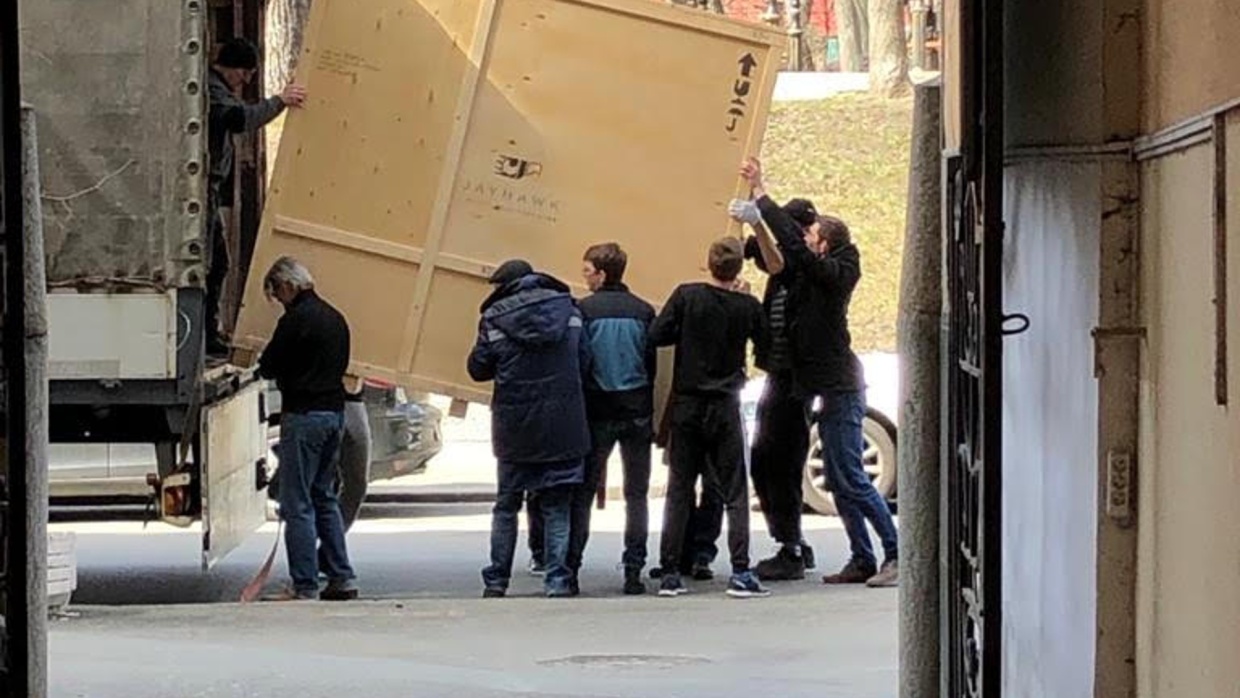
Packing an entire collection into crates at short notice. Procuring dehumidifiers, generators and fire extinguishers so that artworks can be stored and evacuated professionally – ideally while the security situation changes by the day. Protection of cultural assets in wartime rarely starts with a long-term plan. More often, it begins with decisions made under pressure.
Since the start of Russia’s full-scale invasion of Ukraine, the Ukraine Art Aid Center has supported cultural institutions throughout the country with the equipment needed to evacuate or store their holdings as safely as possible. More than 1,200 museums, libraries, archives, theatres and other institutions have now received assistance from the Center. Johannes Nathan, chair of the association, recalls the first months after 24 February 2022: “In many cases, the task was to move collections that had been displayed in exhibition spaces into makeshift storage in underground basements.” These holdings often had to be moved again or evacuated later.
Demand reported to the Center remains high and long ago extended beyond packing material and archival boxes. Institutions need climate-control equipment for emergency storage, backup power in the event of outages and computers when offices have been destroyed. Theatres receive generators so they can continue their programmes. “Ukrainians want to preserve cultural life and their heritage even during the war,” Nathan says. “Life does not stop despite the shelling.”
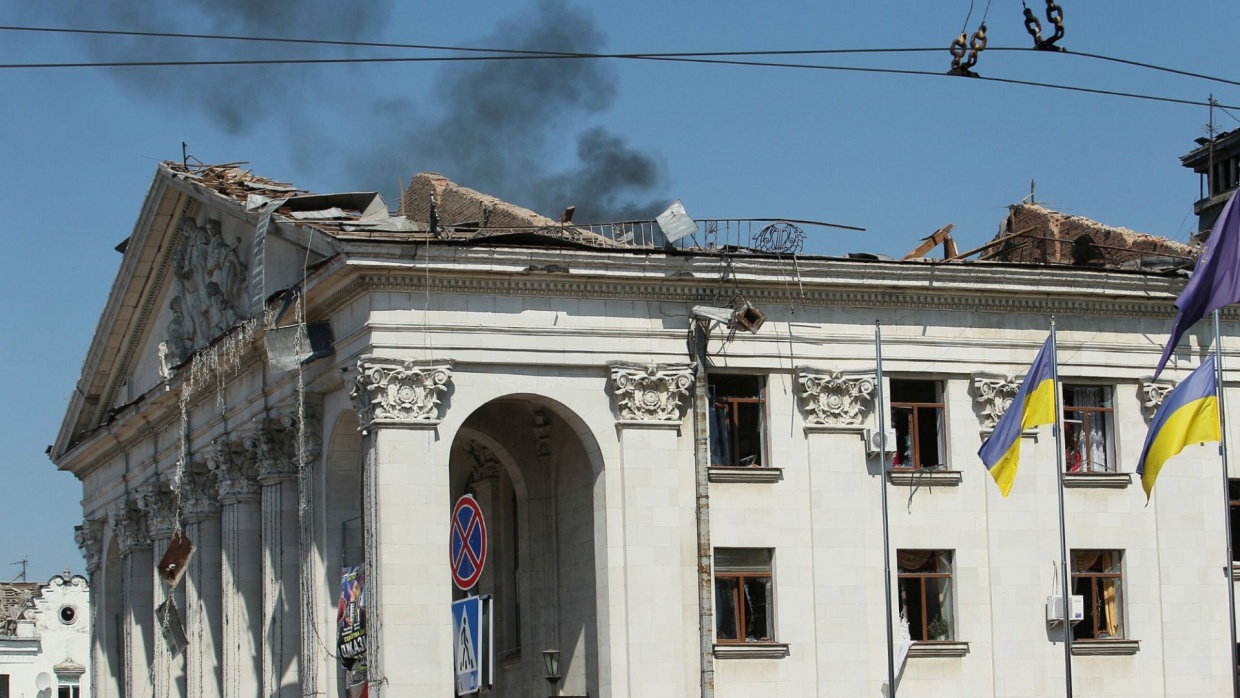
The theatre and opera house in the northern Ukrainian city was severely damaged in a Russian attack on 23 August 2023. The UAAC was the first NGO to organise aid here; other organisations followed. Repairs made it possible for performances to resume within five months. © Chernihiv Academic Regional Music and Drama Theatre “T. H. Shevchenko”
Reconstruction as a return to everyday life
For Vira Orlovska, who is responsible for management and fundraising at the Ukraine Art Aid Center, the situation has intensified further. Financial support is declining while the number of requests is rising. Orlovska cites Kyiv alone: in the first years of the war, some districts could still be considered relatively safe; today, that applies to no neighbourhood. Russian missiles or drones can strike anywhere. More and more institutions therefore want to place their holdings in preventive storage.
It is not always possible to decide from a distance what should happen when a building is hit or a collection is at risk. In occupied areas, institutions and holdings have in some cases disappeared entirely from view, Orlovska reports. The museum in Luhansk, for example, once held around 300,000 objects. After 2014, it was re-established a few kilometres away with a smaller team and only 5,000 objects. After 2022, this museum too came under occupation again – without any possibility of taking the holdings away.
And yet reconstruction is under way in many places. The suburbs of Kyiv, which were extensively destroyed in the first months of the war, have now largely been rebuilt, Nathan says. This matters so that people do not have to live permanently in surroundings that remind them of violence and loss every day. Reconstruction allows at least a minimum of everyday life, neighbourhood life and cultural activity to return, even in wartime.
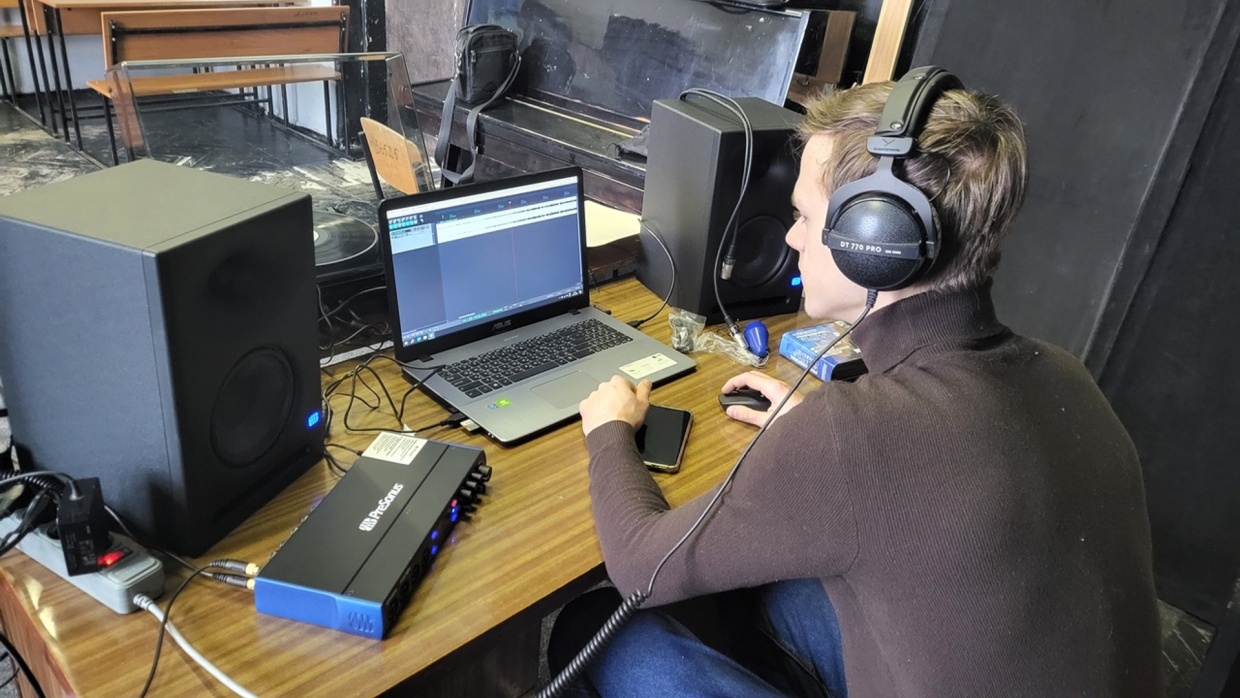
To document endangered music archives, the UAAC is supplying digitisation equipment to two Ukrainian partner institutions: the National Library in Kyiv, which holds collections from the twelfth to the twentieth century, and the library of the National University of Arts in Kharkiv, which focuses primarily on contemporary music. After digitisation, the data will be indexed, scientifically evaluated and archived in cooperation with the Saxon State and University Library Dresden (SLUB). Much of it will then be freely accessible through the RISM database and, where legally possible, via the SLUB website. © Phonotheque of the Kharkiv University “Kotlyarevsky”
Documenting loss, preserving the copy
At the same time, new forms of documentation and remembrance are emerging in Ukraine. Kyiv’s Museum of the Second World War is now collecting documents, photographs and archival material relating to the current war. Virtual projects use 3D reconstructions to make destroyed artworks and buildings visible. In Hostomel, a memorial commemorates soldiers who halted the advance of Russian troops. And in cemeteries, a culture of remembrance – also conveyed through images in other European media – is growing: rows of new graves, yellow-and-blue ribbons and flags make visible what people died for; photographs, keepsakes and letters tell of loss and grief.
Digital documentation plays a part in this too. The team at Skeiron in Lviv records endangered architectural and cultural monuments with laser scanning and photogrammetry; more than 100 objects have already been digitally documented. The laser scanner measures a building’s geometry from many positions, while thousands of photographs add colour, surfaces and wall paintings. Together, they form a precise digital model.
“A digital model is not simply a copy sitting somewhere in a cloud,” stresses Skeiron co-founder Yurii Prepodobnyi. The data can be used for research, conservation and reconstruction. 3D printing can also produce tactile models through which blind people, for example, can experience a monument. Yet digital safeguarding replaces neither the building nor its materiality or atmosphere. It preserves knowledge and opens up possibilities for the time afterwards.
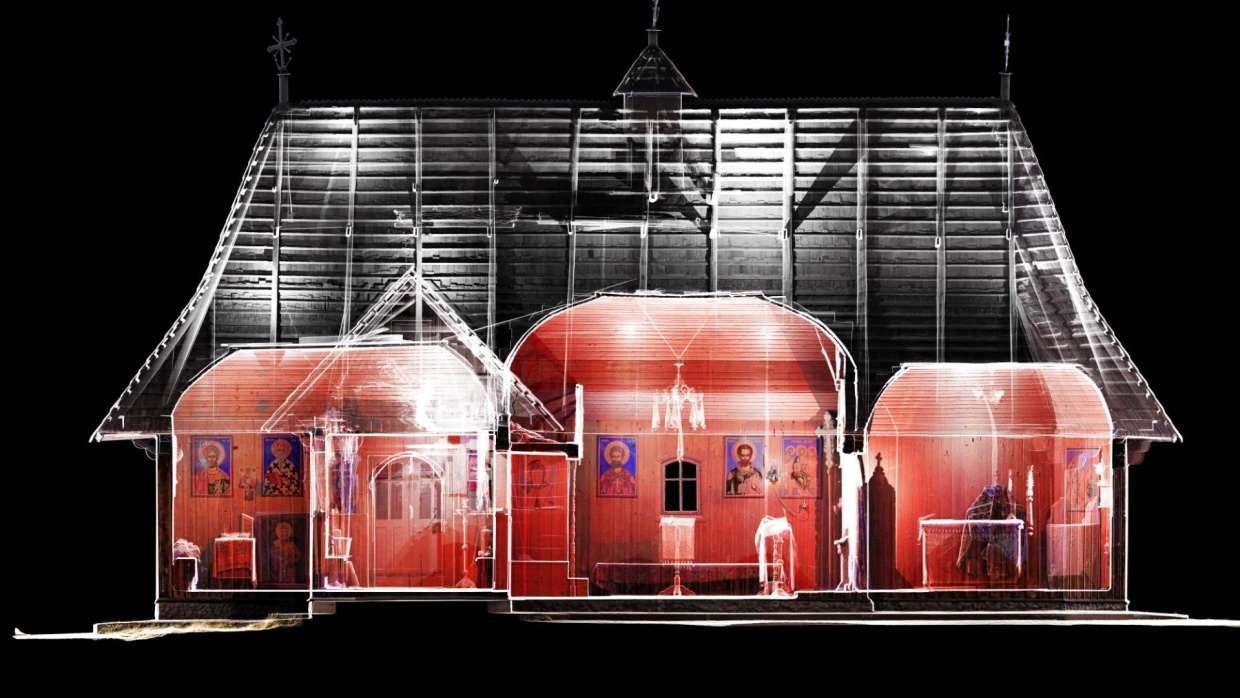
With models such as this, Skeiron helps ensure that reconstruction remains an option in the event of destruction. © Skeiron
Being prepared before it is too late
On 6 November at denkmal, this experience meets a Polish perspective. Michał Krasucki of Poland’s National Institute for Cultural Heritage works on strategies for war scenarios and natural disasters. After 24 February 2022, existing procedures in Poland were fundamentally reviewed. Today, the focus is on institutions’ own preparedness.
“In an emergency, you cannot rely on the army, civil protection or fire service having time for cultural heritage,” Krasucki says. These forces will have other critical tasks to perform. His key conclusion from Ukraine’s experience is therefore self-preparedness: “Institutions must be prepared themselves: with materials, knowledge and a resilient network.”
For cultural institutions in Germany and Europe, this is not an abstract question. Where could holdings be stored in an emergency? Which objects take priority? Who can organise packing material, transport or professional help? And which contacts must already be in place before a crisis begins? Krasucki’s recommendation is clear and resonates: we need to hurry now in order to be able to rely on at least some form of long-term plan when it matters, because: “We don’t have the time.”
Discussion at denkmal 2026:
Saving Ukrainian Cultural Heritage in Wartimes
- Friday, 6 November 2026, 10:15–11:45 a.m.
- denkmal-CAMPUS (Lab), Hall 2, Stand L07
- Language: English with German interpretation