


Exhibitor Details
Exhibitor Details
Product portfolio
Product Groups
Thematic Areas
Program Items

Improving the functionality of our infrastructure is undoubtedly one of the key tasks of the coming decades. The state of repair of many of these structures is a cause for concern. The number of bridges in Germany in urgent need of renovation alone ranges, depending on the source, between 16,000 and 30,000. It is not known exactly how many listed monuments are included in this figure – but there are likely to be quite a few. The so-called ‘special fund’, which the Federal Government approved in 2025, is intended to be allocated largely to the refurbishment of this infrastructure. This will result in numerous construction projects. But what consequences will this have for the listed structures within our infrastructure?
Damage to historic buildings often occurs where regional climatic factors and tried-and-tested construction methods are not taken sufficiently into account. Practical examples clearly illustrate how, through sound planning, investigations and restoration, damage can be prevented and the historic fabric of buildings can be preserved for the long term.
Preserving heritage buildings within the existing built environment. Lessons learnt from the regeneration of a mixed-use residential and commercial building. Six years elapsed between the granting of a demolition permit and the building’s successful revitalisation: today, the Pennig House has been renovated in accordance with heritage conservation principles and is fully let. The presentation highlights the key factors behind the success of this conservation project and explains how the Warburg Heritage Trust, acting in a fiduciary capacity within the German Foundation for Monument Protection, consistently allowed itself to be guided by the historic building and its condition as the project owner.
Staff from the German Foundation for the Preservation of Historical Monuments will outline the key aspects of funding for heritage conservation, from the initial enquiry right through to the award of funding – including the procedure, selection criteria, process and examples.
The house, situated in Aventoft near the Danish border, was purchased in the 1970s by a Berlin artist and his wife, and served as a source of inspiration and a studio. During the restoration, the aim was also to preserve the house’s character as an artist’s home.
With the ‘Black Book of Heritage Conservation’, which was first published in 2025 and has been published annually ever since, the German Foundation for Monument Protection presents an alarming assessment of the state of heritage conservation in Germany. The Black Book is the most comprehensive survey in Germany of lost or endangered monuments, and has received enormous media attention. In this presentation, the German Foundation for the Preservation of Historical Monuments will exclusively outline the idea behind the project, the impetus for it and its conception, as well as the experiences and findings from the two previous editions.
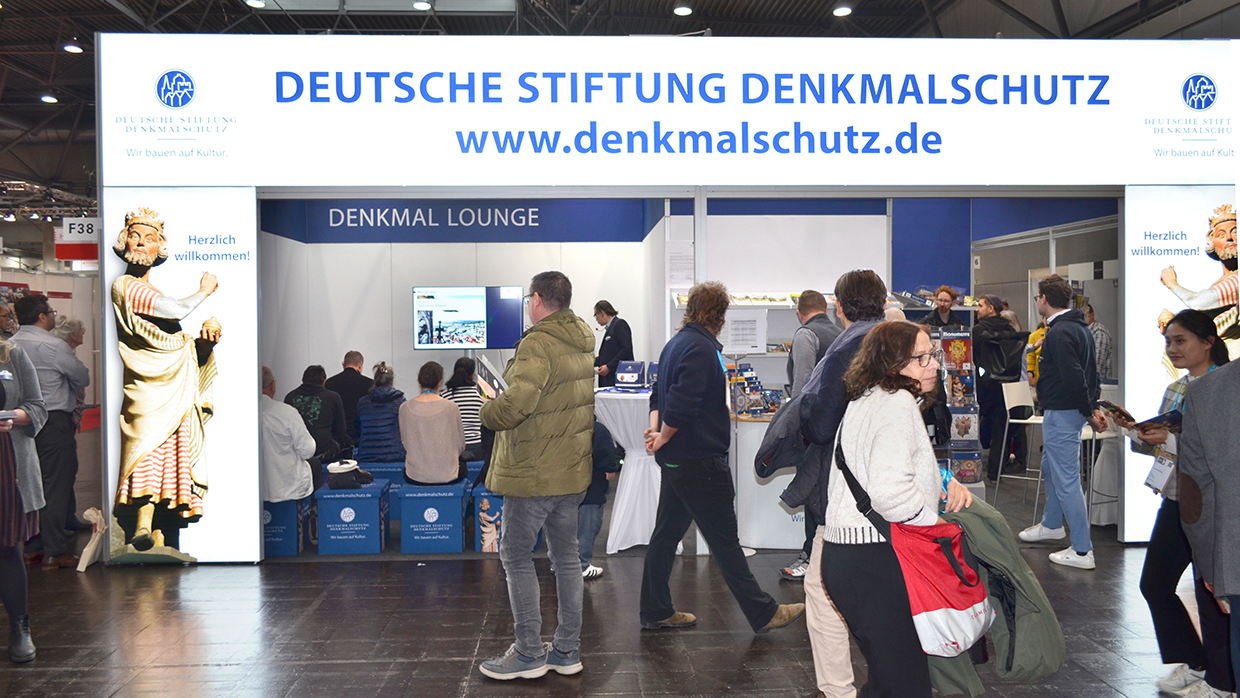
The German Foundation for Monument Protection is holding a daily prize draw at its stand, F40. All you need to do is fill in a prize draw entry form at the stand to be entered into the draw. Every day, we’re giving away prizes from our Monumente publishing range. Good luck!
Closed event for denkmal aktiv participants
denkmal aktiv – Cultural Heritage in Schools The school programme of the Deutschen Stiftung Denkmalschutz An event for teachers taking part in denkmal aktiv. The focus is on careers in the field of heritage conservation and a discussion on career guidance within the context of heritage projects with pupils.
With the ‘Black Book of Heritage Conservation’, which was first published in 2025 and has been published annually ever since, the German Foundation for Monument Protection presents an alarming assessment of the state of heritage conservation in Germany. The Black Book is the most comprehensive survey in Germany of lost or endangered monuments, and has received enormous media attention. In this presentation, the German Foundation for the Preservation of Historical Monuments will exclusively outline the idea behind the project, the impetus for it and its conception, as well as the experiences and findings from the two previous editions.
Staff from the German Foundation for the Preservation of Historical Monuments will outline the key aspects of funding for heritage conservation, from the initial enquiry right through to the award of funding – including the procedure, selection criteria, process and examples.

The generously endowed Peter Parler Prize (PPP) is awarded every two years to stonemasons and stone sculptors working in the field of heritage conservation whose work contributes to the protection and preservation of cultural heritage.
Damage to historic buildings often occurs where regional climatic factors and tried-and-tested construction methods are not taken sufficiently into account. Practical examples clearly illustrate how, through sound planning, investigations and restoration, damage can be prevented and the historic fabric of buildings can be preserved for the long term.
The German Foundation for Monument Protection is holding a daily prize draw at its stand, F40. All you need to do is fill in a prize draw entry form at the stand to be entered into the draw. Every day, we’re giving away prizes from our Monumente publishing range. Good luck!
Improving the functionality of our infrastructure is undoubtedly one of the key tasks of the coming decades. The state of repair of many of these structures is a cause for concern. The number of bridges in Germany in urgent need of renovation alone ranges, depending on the source, between 16,000 and 30,000. It is not known exactly how many listed monuments are included in this figure – but there are likely to be quite a few. The so-called ‘special fund’, which the Federal Government approved in 2025, is intended to be allocated largely to the refurbishment of this infrastructure. This will result in numerous construction projects. But what consequences will this have for the listed structures within our infrastructure?
With the ‘Black Book of Heritage Conservation’, which was first published in 2025 and has been published annually ever since, the German Foundation for Monument Protection presents an alarming assessment of the state of heritage conservation in Germany. The Black Book is the most comprehensive survey in Germany of lost or endangered monuments, and has received enormous media attention. In this presentation, the German Foundation for the Preservation of Historical Monuments will exclusively outline the idea behind the project, the impetus for it and its conception, as well as the experiences and findings from the two previous editions.
Damage to historic buildings often occurs where regional climatic factors and tried-and-tested construction methods are not taken sufficiently into account. Practical examples clearly illustrate how, through sound planning, investigations and restoration, damage can be prevented and the historic fabric of buildings can be preserved for the long term.
Staff from the German Foundation for the Preservation of Historical Monuments will outline the key aspects of funding for heritage conservation, from the initial enquiry right through to the award of funding – including the procedure, selection criteria, process and examples.
"Schwarzbuch der Denkmalpflege" (DSD, Frau Masthoff), 30 bis 45 min
The German Foundation for Monument Protection is holding a daily prize draw at its stand, F40. All you need to do is fill in a prize draw entry form at the stand to be entered into the draw. Every day, we’re giving away prizes from our Monumente publishing range. Good luck!
Contact
Deutsche Stiftung Denkmalschutz (DSD)
Schlegelstr. 1
53113
Bonn
Germany
Phone: 0228 90910
Fax: 0228 9091109